Friday, November 14, 2008

The Peak Oil Crisis: The First Rule of Holes


 Thursday, 13 November 2008: America has dug itself into the deepest hole it has been in since 1860 when the dispute over slavery reached its zenith. 

That hole took five years of war and 150 years of social discord before we could start climbing out. The current hole, reliance on fossil fuels for nearly everything, will also take many decades of hardships to work itself out.

For now however, digging our hole deeper continues everywhere. Oversized gas-guzzling automobiles continue to be built and sold by the millions. New generations of kerosene-guzzling airliners are being readied for the market. Houses and all sorts of buildings requiring excessive amounts of energy to be habitable continue to be built. Roads are being widened and lengthened. Our great national hole deepens every day.

Getting out of this hole will not be painless.

At the top of the national agenda this week is what to do with the automobile industry which employs millions, is burning through billions each month, and will be utterly bankrupt by New Years. More >>>

Wednesday, November 12, 2008

Peak Oil: Get Ready for the Oil-Supply Crunch, IEA Says


November 12, 2008 - Lower oil prices these days are both a result of the economic slowdown and a possible cushion. But they could be a very mixed blessing.

The Paris-based International Energy Agency is worried about an oil supply crunch in coming years. It’s not due to geology—the IEA says the world has plenty of oil, in one form or another. But trying to match oil supplies to growing oil demand in coming years is a Herculean task made all the harder by cheapish crude prices which make oil companies think twice about new investments.

The biggest challenge will come between 2010 and 2015, the IEA says in its 2008 World Energy Outlook. For the next couple of years, the oil pipeline is well supplied. But that trails off after 2010. By 2015, the world needs to find an additional 7 million barrels per day of oil above and beyond all the exploration projects currently in the pipeline. And to get that oil to market by the middle of the decade, those exploration projects need to get started now. More >>>

Sunday, November 9, 2008

OPEC to cut supply in December if market unchanged - Iran


DUBAI (Reuters) Sun Nov 9, 2008 - OPEC will cut oil output again if the trend towards lower prices and slowing demand growth are unchanged when the group meets in December, Iran's OPEC Governor Mohammad Ali Khatibi told Reuters on Sunday.

The credit crisis and economic slowdown could shave as much as 3 million barrels per day (bpd) from global crude demand, Khatibi said.

"If everything is the same and the trends continue like this then OPEC will have to do something," Khatibi said in an interview by telephone.

"We have to balance the market. Recent indications are that demand could have fallen by 2 to 3 million barrels per day. Stocks are rising."

Oil dipped below $60 a barrel last week, the lowest since March 2007, and has tumbled nearly 60 percent from its July peak over $147. More >>>
˙

The day the oil runs dry


Abu Dhabi{ 08 November 2008 - For centuries civilisations have been built on trade. Athens on silver, Rome on wine and olive oil. The UAE, however, is built on a different kind of oil. But its reserves cannot last forever, which has seen two cities embark along very different paths, as Jamie Stewart reports.

The Kempinski Emirates Palace, Abu Dhabi, is home to an exhibition showcasing the under-construction Saadiyat Island development. An exhibition that has been toured, among many, by one George W Bush.

The exhibition is bordered by a wall covered with facts and figures concerning the growth of the UAE. Hidden among this wall is a white board sporting a series of bar charts that may have raised the eyebrows of a keen-eyed Bush on his January visit to the capital.

We are looking at how to incorporate the culture and heritage of Abu Dhabi.

As the chart states, in 1975, 21.2% of the UAE's gross domestic product was generated by the service sector, while 67.7% came from the mining and oil industries. By 2005, the service sector accounted for 42.1%, while mining and oil accounted for just 32.8%.

Oil, as we know, cannot last forever. Both Abu Dhabi and Dubai have begun to demonstrate that it's time to begin laying the groundwork within which their societies can operate without the financial benefits and guarantees that oil brings to the respective populations. More >>>

Thursday, November 6, 2008

Peak Oil: You Can Run, But You Can’t Hide From Higher Oil Prices


November 6, 2008 - What does it say when the normally conservative International Energy Agency is even gloomier than already depressed markets? That this autumn’s relatively cheap oil is likely a flash in the pan—and that triple-digit oil will soon be a permanent fixture again.

The Paris-based IEA, energy adviser to rich countries, is warning that crude oil will average $100 a barrel between 2008 and 2015 because of a looming supply crunch. That’s a more pessimistic take than the oil market itself, which prices forward oil futures contracts in the $80s (for 2010 and 2011) and around $90 (for 2012 and 2013). The biggest cause of that coming crunch, the IEA says, is “under-investment” in new and existing fields in order to make sure oil production keeps pace with production declines and growing global demand. More >>>

Wednesday, November 5, 2008

Solar Power Game-changer: 'Near Perfect' Absorption Of Sunlight, From All Angles


ScienceDaily (Nov. 4, 2008) — Researchers at Rensselaer Polytechnic Institute have discovered and demonstrated a new method for overcoming two major hurdles facing solar energy.

By developing a new antireflective coating that boosts the amount of sunlight captured by solar panels and allows those panels to absorb the entire solar spectrum from nearly any angle, the research team has moved academia and industry closer to realizing high-efficiency, cost-effective solar power. “To get maximum efficiency when converting solar power into electricity, you want a solar panel that can absorb nearly every single photon of light, regardless of the sun’s position in the sky,” said Shawn-Yu Lin, professor of physics at Rensselaer and a member of the university’s Future Chips Constellation, who led the research project. “Our new antireflective coating makes this possible.”
More >>>

Tuesday, November 4, 2008

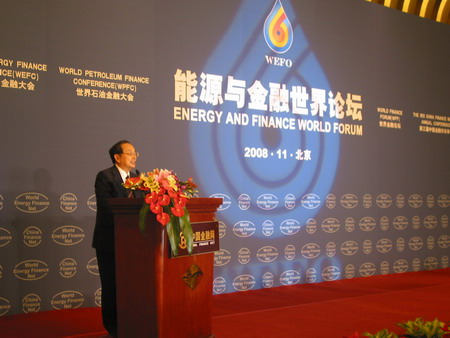
Energy forum to discuss sustainable development amid crisis


November 03 2008: Jiang Zhenghua, economist and former vice chairman of the Standing Committee of the National People's Congress, speaks at the opening ceremony of the World Energy Finance Conference in Beijing on November 2, 2008.

With the global financial troubles and oil prices fluctuating dramatically, experts from across the world gathered in Beijing yesterday to discuss global finance and energy security and solutions for sustainable development.

Held between November 2 and 5 at Diaoyutai Hotel, the World Energy Finance Conference has attracted government officials, economists and business executives from over 30 countries in energy, finance, and science and technology sectors.

But even more appealing are the two key words in the forum's theme -- Finance and Energy, which have been closely connected to the nation's development as well as individuals' pockets.

The latest financial storm started in the US has been sweeping from Wall Street to main streets across the world. Accompanying the financial crash is the landslide of international oil prices, which have plummeted from a historic high of $147 a barrel in July to $67 last week. More >>>