Sunday, September 21, 2008

Energy security 'more important than climate change'

September 17 2008 Securing the country's supply of electricity is more important than tackling climate change, a new report from energy analysts has claimed.

It warned that the UK's economy could be wrecked if there was no action to plug the energy shortfall predicted for the next decade, with businesses going bust and hundreds of thousands of people losing their jobs.

But the report, led by Ian Fells, emeritus professor at the University of Newcastle and a veteran energy policy analyst, has been dismissed as "naive" by Greenpeace, and "overstated" by the energy secretary John Hutton. Environmentalists argued that the report's recommendation for new coal-fired power stations went against the advice of scientists and that the rest of the world was forging ahead with renewables.

The report said the government had to consider extending the lifespan of the UK's ageing coal and nuclear power stations to meet the impending shortage. Otherwise, Fells warned, the UK would be be hit by repeated power cuts that would shut down public transport, reduce hospital services and cause chaos in supermarkets and offices. "Electricity is the life blood of civilisation. Without it we spiral down into anarchy and chaos. More >>>
[Only through the use of carbon capture and storage / sequestration could we continue using coal fired power plants. Ed]

Saturday, September 13, 2008

Legal and Ethical Issues Raised by Waiting for Geological Carbon Storage


Ethical Issues Raised by Waiting for Geological Carbon Storage

August 10th, 2008:
This post examines ethical issues that arise when a government does not take action to reduce its greenhouse gas (GHG) emissions from coal fired powered plants because it plans to eventually use carbon capture and geologic storage technology (geologic carbon storage) to sequester carbon dioxide produced in coal combustion.

As more fully set out in a prior post, geologic carbon sequestration is a hopeful but unproven technology for reducing climate change’s threat which raises a number of ethical issues that should be considered in regard to its deployment. (http://climateethics.org/?p=38)

This post looks in more detail at one of these ethical issues, that is, ethical issues that arise by waiting for this hopeful but unproven technology to be perfected while continuing to emit GHG from existing coal fired power plants. More >>>

Monday, September 1, 2008

Global warming: Sea level rises may accelerate due to melting ice sheet

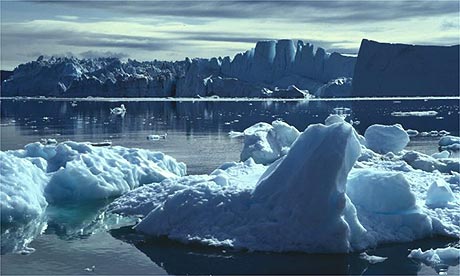
By the end of the century sea levels may be rising three times as fast as they are at present, as a result of rapid melting of the Greenland ice sheet

The vast Greenland ice sheet could begin to melt more rapidly than expected towards the end of the century, accelerating the rise in sea levels as a result of global warming, scientists warned yesterday.

Water running off the ice sheet could triple the current rate of sea level rise to around 9mm a year, leading to a global rise of almost 1 metre per century, the researchers found. More >>>

Friday, August 22, 2008

Geologist: In Terms of Supply and Demand, the Oil Peak Is Past

Jeffrey Brown is an independent petroleum geologist and analyst, who also manages an exploration program in West Texas. He has a major interest in the subject of "Peak Oil" and has used mathematical models to project a very grim future for the world's oil supply. We caught up with Jeffrey at his office outside Dallas.

Eli Neusner, reporter, You've published some controversial research in the past. What is the gist of your analysis?

Jeffrey Brown, petroleum geologist (Brown): The basic thrust of my research is that the world has already arrived at Peak Oil - which is a condition in which the worldwide supply of oil cannot keep up with demand. We have used proven mathematical models to show that the top five net oil-exporting countries - which are Saudi Arabia, Russia, Norway, Iran and the United Arab Emirates, and which account for one-half of current world net oil exports - are showing an ongoing decline in net oil exports, continuing a trend that began in 2006. To give you an idea of where we're headed, Mexico - another former top producer - will see its oil exports hit zero in 2010.
More >>>

Friday, August 15, 2008

Oil-addicted world faces crude awakening

As petrol prices reach record levels, the maker of an award-winning Swiss film on peak oil talks to Swissinfo about an issue which is affecting everyone, everywhere.

(15/08/08) - Described as "one of the most frightening films you are ever likely to see" by British newspaper The Guardian, "A Crude Awakening" is essential viewing for anyone wanting to understand the current crisis and why the future is far from rosy.

The documentary, known as "The Oil Crash" outside English-speaking countries, argues that we are moving from a period of cheap, abundant energy to a period of expensive, hard-to-get energy. Since not only politicians but almost everyone - business, the oil multinationals - have failed to anticipate the problem and invest in alternative energy sources, it's going to hurt.

Wars over resources, inflation, economic slowdown, food shortages and a collapsing airline industry are just some of the expected consequences of an addicted world being forced to wean itself off oil.

Oil prices have jumped 50 percent in 2008 alone, battering the economies of consumer nations already hit hard by the global credit crunch.

"A Crude Awakening," which won the Zurich Film Prize in 2006 and has been distributed in more than 20 countries, was made by Swiss journalist Basil Gelpke and Irish-born filmmaker Ray McCormack, who has lived in Zurich since 2000. More >>>

Sunday, August 10, 2008

10 Steps in 10 Years to 100 % Renewable Energy

Post Carbon Institute Releases Plan For Al Gore's Generational Challenge To Repower America SEBASTAPOL, CA, July 25, 2008 Post Carbon Institute today announced a comprehensive 10-point plan to achieve Vice President Al Gore’s goal of 100% renewable energy in 10 years:

1. Reduce 6. Reinvest
2. Share 7. Relocalize
3. Diversify 8. Reengineer
4. Distribute 9. Reskill
5. Store 10. Remobilize

A detailed framework has been released online at http://www.postcarbon.org to serve as a guide for policy makers, citizens, and businesses.

“Climate Change is the greatest environmental crisis that humanity has ever faced, but it is not the only serious challenge confronting us. There is a simultaneous 'source' problem, known as peak oil, arising from the depletion of the fuels we are burning, particularly petroleum.

The solution to both climate change and peak oil is to develop renewable sources of energy, to use less energy, to use energy differently—and to make this shift as rapidly as possible," said Richard Heinberg, Senior Fellow, Post Carbon Institute.

"Al Gore’s ambitious goal provides a national focus and call to action. Now what’s needed is a clear-sighted plan for achieving it, one that recognizes the complex issues of energy depletion, the vulnerability of the supply chain and the limits of technology. We are taking up Gore’s call and presenting a powerful framework to realize this vision, a vision that would revitalize America and make it genuinely sustainable." More >>>

Sunday, August 3, 2008

Lies the Oil Companies Peddle

The current use of mythology in politics is not really new—it has been a tool of politicians for many, many years. For example, gasoline prices shooting beyond four dollars a gallon has paved the way for loud shouting by those pols who side with the oil companies and who are calling for more oil drilling in heretofore prohibited areas in America and off our shores.

Open the ANWR for drilling and our energy problems will be solved, is one of President Bush’s favorite war cries.
He has always done what he could for his friends in the oil industry, in particular by very recently canceling an executive order prohibiting drilling in certain offshore areas, claiming, he says, that it will solve our energy problems. More >>>