Tuesday, September 22, 2009

Firms Start to See Climate Change as Barrier to Profit


Monday, September 21, 2009 - As the real-world impacts of climate change begin to materialize and regulation of greenhouse gases appears more likely, corporate America has begun to grapple with a challenging question: How do you quantify the risks associated with climate change?

The answer depends on one's perspective. But companies are beginning to show increased willingness to disclose the extent to which they're contributing to global warming and what they're doing to keep it from harming their business.
"If we don't move now, it just becomes more expensive, more complicated and a bigger risk," said Brad Figel, director of government affairs at Nike, at a Capitol Hill briefing last week sponsored by Oxfam America.

On Monday, the Carbon Disclosure Project is set to release a report surveying the climate policies of the majority of the S&P 500, in which 52 percent of respondents said they've set emissions-reduction targets for the companies, compared with 32 percent last year. Many of these groups also see global warming as a threat to their bottom lines -- including 84 percent of financial-sector respondents -- citing concerns including a potential shortage of raw materials and supply-chain disruptions because of severe weather. More >>>

Friday, September 18, 2009

Gigascale Solar


Fri, September 11, 2009 - The Wall Street Journal and The New York Times report this week what could be another first for First Solar: a preliminary agreement with the Chinese government to build a 2-gigawatt photovoltaic farm in Inner Mongolia.

If the plant is actually built, it will be in stages over a decade, to cover eventually as much as 25 square miles. But "much of the deal hasn't been worked out yet," says the Journal with some understatement--minor details such as how much First Solar might be paid have yet to be settled. The company's plan is to sell the plant to a Chinese operator upon its completion, but the plant's profitability will depend on the size of the subsidies it would be eligible for. That's another detail to be worked out, as China right now is trying to decide whether to adopt a feed-in tariff that would guarantee returns on investments in renewables. More >>>

Thursday, September 17, 2009

Schwarzenegger boosts clean energy plan

SAN FRANCISCO (Reuters) Wed Sep 16, 2009 - California's governor on Tuesday ordered that a third of the state's electricity come from renewable resources by 2020, the same amount as a legislature plan but with promises to let power companies get more electricity from outside the state.

Governor Arnold Schwarzenegger said that his plan would help the state better meet its clean energy target by making it easier to import power. He also said the legislature's alternative would have required solar thermal plants to clear more regulatory hurdles before they could be built. More >>>

Thursday, September 3, 2009

Bioneers Conference

The Bioneers Conference is a leading-edge forum—join us in San Rafael, California, October 16-18 (with intensives October 15 and 19). At this premiere environmental conference, social and scientific innovators focus on solutions inspired by nature and human ingenuity.

The 2009 Bioneers Conference includes plenary speeches from: Amazonian Chief Almir, Brock Dolman, Kari Fulton, Jack Hidary, Sarah James, Jensine Larsen, Joanna Macy, Mari Margil, Jason McClennan, Michael Pollan, Jerome Ringo, Arturo Sandoval, Dr. Andrew Weil, Lily Yeh and more!

Andrew Weil Chief Almir Joanna Macy Michael Pollan
Andrew Weil, M.D.
Almir Narayamoga Surui Joanna Macy Michael Pollan

These visionaries are already creating the healthy, diverse, and more equitable world we want to live in—our legacy for future generations. Connect with engaged bioneers, who are making a real difference. More >>>

Tuesday, July 28, 2009


Tuesday, 19 May 2009 - Smart meters will play a central role in delivering an energy infrastructure fit for the 21st Century, says Stephen Cunningham. In this week's Green Room, he argues why he believes the technology will help deliver the necessary carbon saving needed to prevent dangerous climate change.

If time waits for no man, climate change is even more ruthless.
Yet people in the UK, along with much of Europe, have been waiting for years for the intentions of government and its increasingly ambitious carbon reduction targets to be reinforced with decisive implementation plans.
Last week, that wait came to an end - at least in the field of energy management.
Industry has finally been given the backing it needs to unlock the potential of "smart metering". More >>>

Thursday, June 18, 2009

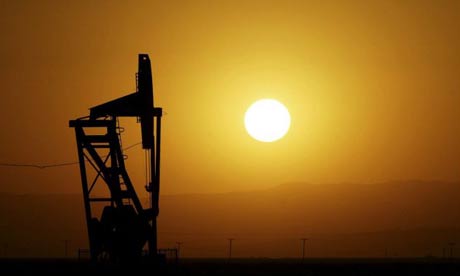
Oil price leaps to year's high


Predictions of $250 a barrel on fears for oil reserves, hopes of economic recovery and hedging against weak dollar .

10 June 2009 20.58 BST - The price of oil burst through the $71 a barrel mark today amid revelations that proven reserves had fallen for the first time in 10 years and predictions that the price could eventually hit $250.
The latest high – from lows of $30 only four months ago – came on the New York Mercantile Exchange, where the cost of July deliveries rose by $1.35 to $71.36.

This comes on top of a $2 rise the day before as investors rushed into the market on the back of lower stockpile figures, higher demand estimates and speculation against further falls in the dollar.
"I wouldn't be surprised if we're testing $80 in a week or two," said one analyst, while BP's chief executive, Tony Hayward, questioned whether $90 could be the "right" value. More >>>

Thursday, June 11, 2009

The Peak Oil Crisis: A Letter From Baghdad


10 JUNE 2009 20:27 - A couple of weeks back the peak oil community received a letter from an officer serving with our forces in Iraq.

Despite numerous distractions in Iraq these days, this officer is so concerned that peaking world oil production will soon become a serious problem that he began discussing the future of America's energy supply with soldiers in his unit. What he concluded has a message for us all.

He found that most people have no trouble accepting the premises of peak oil- that there is a finite amount of crude underground, that the easy and cheap to extract oil is nearly gone and that world production will go into an unstoppable decline. The disconnect from reality, however, comes when contemplating the consequences of this event, for nearly all believe there are many obvious alternatives to oil. We know what they are: nuclear, solar, wind, waves, tides, shale, oil sands, coal-to-liquid, biomass, etc., etc. In the mind of most, it is a rather simple matter of switching from oil to any or all of the alternatives so that life-as-we-know-it can continue without missing a beat. More >>>