Showing posts with label Russia. Show all posts

Friday, October 30, 2015

The long-term petroleum price outlook - When will it escalate?

For the last few years, the Saudi kingdom’s insistence on pumping oil at high capacity has dramatically depressed oil prices. The result has undermined Saudi’s major oil rivals in OPEC – like Iran and Venezuela.

It has also hit Russia, hard.

Rating agency Standard & Poor forecasts that Russia’s budget deficit is set to swell to 4.4 per cent of GDP this year. Russia’s own finance ministry concedes that if expenditures continue at this rate, within sixteen months – by around the end of next year – its oil reserve funds will be exhausted.

Meanwhile, over the last year real incomes have dropped by 9.8 per cent, and food prices have spiked by 17 per cent, heightening the risk of civil unrest.

System failureh

Rumbling along beneath the surface of such financial woes are deeper systemic issues.

A report from the Swedish Defence Research Agency notes that “prolonged dry periods in southern Russia are having the effect of reducing the level of food production”.

Most of Russia’s wheat imports come from Kazakhstan, “where climate change is expected to exacerbate droughts. These impacts would make farming harder and food more expensive,” observe Dr. Marina Sharmina and Dr. Christopher Jones of the Tyndall Centre for Climate Change Research.

Russia’s looming energy crisis is the other elephant in the room. In 2013, HSBC forecasted that Russia would hit peak oil between 2018 and 2019, experiencing a brief plateau before declining by 30 per cent from 2020 to 2025.

That year, Fitch Ratings came to pretty much the same conclusion. And last year, Leonid Fedun, vice-president of Russia’s second largest oil producer, Lukoil, predicted that the production could peak earlier due to falling oil prices and US-EU sanctions.

Faced with overlapping economic, food and energy crises, Russia is well and truly on the brink. More

Furthermore, According to a recent report from the IMF, Saudi Arabia’s public debt is estimated to rise from below 2 percent of its GDP in 2014 up to 33 percent by the end of 2020. The report also shows that in the past three years, Saudi Arabia’s budget surplus was turned into a deficit reaching 21.6 percent of GDP in 2015. More


Sunday, November 9, 2014

Russia, China Sign Second Mega-Gas Deal: Beijing Becomes Largest Buyer Of Russian Gas

As we previewed on Friday, when we reported that "Russia Nears Completion Of Second "Holy Grail" Gas Deal With China", moments ago during the Asia-Pacific Economic Cooperation forum taking place this weekend in Beijing, Russia and China signed 17 documents Sunday, greenlighting a second "mega" Russian natural gas to China via the so-called "western" or "Altay" route, which as previously reported, would supply 30 billion cubic meters (bcm) of gas a year to China.
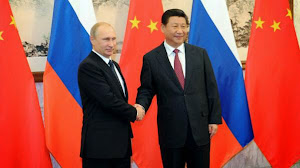
Russian President Vladimir Putin and Chinese leader Xi Jinping

Among the documents signed between Russian President Vladimir Putin and Chinese leader Xi Jinping were the memorandum on the delivery of Russian natural gas to China via the western route, the framework agreement on gas supplies between Russia's Gazprom and China's CNPC and the memorandum of understanding between the Russian energy giant and the Chinese state-owned oil and gas corporation.

"We have reached an understanding in principle concerning the opening of the western route," Putin said. "We have already agreed on many technical and commercial aspects of this project, laying a good basis for reaching final arrangements."

RIA adds, citing Gazprom CEO Alexei Miller, that the documents signed by Russia and China on Sunday define the western route as a priority project for the gas cooperation between the two countries.

"First of all these documents stipulate that the "western route" is becoming a priority project for our gas cooperation," Miller said, adding that the documents provide for the export of 30 billion cubic meters of Russian gas to China annually for a 30-year period.

Miller noted that with the increase of deliveries via the western route, the total volume of Russian gas deliveries to China may exceed the current levels of export to Europe in the medium-term perspective. In other words, China has now eclipsed Europe as Russia's biggest, and most strategic natural gas client. More:

Miller, who heads Russia's state-run energy giant, told reporters that "taking into account the increase in deliveries via 'western route,' the volume of supplied [natural gas] to China could exceed European exports in the mid-term perspective."

This came after Russian and Chinese energy executives signed on Sunday a package of 17 documents, including a framework deal between Gazprom and China's energy giant CNPC to deliver gas to China via the western route pipeline.

Miller said Gazprom and CNPC were in talks on a memorandum of understanding that would see Russia bring gas to China through the western route pipeline, as well as a framework agreement between the two state-owned companies to carry out the deliveries.

The western route will connect fields in western Siberia with northwest China through the Altai Republic. Second and third sections may be added to the pipeline at a later date, bringing its capacity up to 100 billion cubic meters a year.

The facts and figures of the Altay deal are broken down in the following map courtesy of RT

Also of note, among the business issues discussed by Putin and Xi at their fifth meeting this year was the possibility of payment in Chinese yuan, including for defense deals military, Russian presidential spokesman Dmitry Peskov was cited as saying by RIA Novosti. More from RIA:

Russia's President Vladimir Putin and China's President Xi Jinping have discussed the possibility of using the yuan in mutual transactions in different fields of cooperation, Kremlin spokesman Dmitry Peskov said Sunday.

"Much attention has been paid to the topic of mutual payments in diverse fields ... in yuans which will help to strengthen the yuan as the region's reserve currency," Peskov said commenting on the meeting held between Putin and Xi on the sidelines of the Asia-Pacific Economic Cooperation (APEC) summit in Beijing.

On October 13, Russian Economic Development Minister Alexei Ulyukayev announced that Russia was considering Chinese market to partially substitute access to the financial resources of the European Union and the United States.

The European Union and the United States have imposed several rounds of economic sanctions on Russia over its alleged involvement in the Ukrainian crisis, a claim Moscow has repeatedly denied. The restrictions prohibit major Russian companies from seeking financing on western capital markets.

Meanwhile, as China and Russia keep forging ahead in a world in which the two becomes tied ever closer in a symtiotic, dollar-free relationship, this is how the US is faring at the same meeting: "China, U.S. Parry Over Preferred Trade Pacts at APEC: Little Progress Made on Separate Trade Deals at Asia-Pacific Economic Cooperation Forum."

The U.S. blocked China’s initiatives because it worried that launching FTAAP talks would impede progress on a separate trade deal, the Trans-Pacific Partnership. The ministers’ statement said that any FTAAP deal would build on "ongoing regional undertakings"—a reference to TPP and other regional trade deals.

"The Chinese got all they could expect—a reaffirmation that we all share in the vision of having a regional integrated model" for trade, said U.S. Chamber of Commerce Executive Vice President Myron Brilliant.

U.S. Secretary of State John Kerry said Saturday that negotiating the TPP "is a battle that we absolutely must win." Ministers from the 12 TPP nations met Saturday afternoon to try to narrow differences, including disputes between the U.S. and Japan over agriculture and auto trade. On Monday, the leaders of the TPP nations are again scheduled to discuss the trade deal, although no breakthrough is expected.

The U.S. is trying to tie an ITA deal to progress on other trade deals with China, as a way to increase its leverage with Beijing. "How the ITA negotiations proceed is an important and useful data point" on China’s ability to negotiate an investment treaty with the U.S., Mr. Froman said.

Trade analysts say the U.S. also hopes to use China’s desire to have the Beijing conference produce concrete results as leverage. This is the first major international summit held in China since Xi Jinping took over as Communist Party chief in 2012, and the government wants to use the session to affirm China’s greater role in the world.

Good luck trying to "increase US leverage with Beijing" using a trade conference being held in Beijing as the venue.

In other words instead of actual trade agreements, the US merely jawboned and "shared visions."

Then again, as noted here since 2010, in a world in which one can merely "print one's way to prosperity", what is the need for actual trade? Surely, which China and Russia are expanding their commercial ties at the expense of Europe, the US can continue to pretend it is the world's only superpower and has no need for either Russia or China. After all, Mr. Chairmanwoman can always go back to work and print some more of that "world reserve currency." More


Thursday, November 6, 2014

Reducing European Dependence on Russian Gas

Executive Summary

The main finding of this paper is that there is limited scope for significantly reducing overall European dependence on Russian gas before the mid-2020s.

However, countries in the Baltic region and south-eastern Europe which are highly dependent on Russian gas, and hence extremely vulnerable to interruptions, could substantially reduce and even eliminate imports of Russian gas by the early 2020s, by a combination of LNG supplies and pipeline gas from Azerbaijan. Similar measures could reduce (but not eliminate) the dependence of central Europe and Turkey on Russian gas. In the majority of countries, there is limited scope to reduce gas with oil products, and to the extent that it is replaced by coal in power generation carbon emissions will increase significantly.

Up to the mid-2020s, European companies are contractually obliged to import at least 115 bcm/year of Russian gas (approximately 75 per cent of the 2013 import level), a figure which reduces to around 65 bcm by 2030. Even if long-term contracts disappear, our modelling shows a requirement of at least 100 bcm/year of Russian gas up to 2030, and in some scenarios up to twice that volume. The main additional source of non-Russian gas for Europe up to 2030 will be LNG; pipeline gas imports from domestic and other imported sources are not envisaged to increase substantially and may decline. Russian gas deliveries to Europe will be highly competitive with all other pipeline gas and LNG (including US LNG) supplies throughout the period to 2030, and Gazprom's market power to impact European hub prices may be considerable.

Countries with strong geopolitical fears related to Russian gas dependence will need to either terminate, or not renew on expiry, their long-term contracts with Gazprom. This will result in substantial additional infrastructure costs for LNG import terminals and pipeline connections, or investments in alternative energy sources, energy conservation, and efficiency measures.

Whatever the political relationship between Russia, the European Union, and individual European countries, a continued natural gas relationship will be necessary and needs to be carefully managed. The most immediate problems are: a resolution of the Ukrainian transit situation, and a successful conclusion of the EU's regulatory treatment of the South Stream pipeline. Once the immediate crisis has passed, both sides need to discuss the future role of gas in EU energy balances, together with its potential contribution to the EU's ambitious carbon reduction targets. Download PDF


Monday, August 27, 2012

Energy expert says world's oil production has peaked

Every year in August there is a weeklong event, the Oil & Gas Conference. It’s in Denver and draws an international audience. By most accounts EnerCom is the best on the schedule.

This year 121 companies were scheduled to make presentations. If I were allowed to hear only one presentation, and attend one breakout session, I’d choose Core Labs — hands down.

“The maximum yearly oil production of the planet is taking place now!” That came from the CEO of a Netherlands-based company that has 70 offices in 50 countries worldwide. Their business is analyzing drilling results for all major companies and hundreds of smaller firms in the global energy-finding industry.

The company, Core Labs (NYSE: CLB $121), has a unique view of the big picture that few, if any, others could envision. As a byproduct of their normal business activities, CLB accumulates data about the current status of all major oil and gas basins on the planet. Annual revenues are $1 billion.

While an exploration company is drilling, CLB evaluates the rock samples and evaluates the potential of finding oil and gas below. After an oil or gas field is producing, CLB helps the well operators to extract the maximum amount of hydrocarbons from the reservoir. Information that extensive about all the major energy basins in 50 countries is a unique collection of data.

Never very bashful in the breakout session, CEO Dave Demshur readily offered his thoughts about the big energy picture. When queried about predictions of increased oil availability he took the under in most cases. Basically he looks for flat, or lower, future oil generation from Mexico, Iraq, Iran, North Sea, Russia, and the shocker Saudi Arabia. More


Friday, October 15, 2010

Moscow and Chávez agree nuclear pact

Hugo Chavez
October 15 2010  -President Hugo Chávez has announced a deal for Russia to build a nuclear power station in Venezuela, as well as making further arms purchases and establishing a binational bank.

“Venezuela is on its way to getting nuclear power. I hardly need to say so, but I’ll say it anyway: for peaceful purposes, of course,” said Mr Chávez on Friday during his ninth visit to Moscow. “They’ll say that we are going to build atomic bombs. No we are not . . . Nothing is going to stop us, we are free, sovereign and independent.”

Dmitry Medvedev, Russia’s president, said: “Our intentions are absolutely pure and open: we want our partner Venezuela to have a full range of energy possibilities.” More >>>

Sergei Kiriyenko, head of Rosatom, Russia’s state nuclear corporation, said that Russia declined to be specific about the time- frame for the construction of the power station. “Maybe in 10 years, maybe earlier,” he said. More >>>