Showing posts with label Iran. Show all posts

Friday, July 24, 2015

Is the Iran deal about staving off the coming oil shock - By Nafeez Ahmed

The Iran nuclear deal signals a major shift in the geopolitics of the Middle East. Integral to the equation is oil, economics, terror – and US hegemony.

The Bush administration had initiated a long-term covert strategy to undermine Iranian influence in the Middle East and Central Asia, combined with overt pressure through diplomatic initiatives and economic sanctions.

Under Obama, this strategy accelerated, largely in concert with other Gulf powers like Saudi Arabia, Qatar and the UAE, who have long sought to roll-back Iranian influence.

Yet even as the strategy accelerated, unlike its predecessors which openly declared their warmongering hostility to Iran, the Obama administration had used the pressure to forge an unprecedented deal with the country.

Averting regional war

The reasons for the shift are, of course, pragmatic. For years, US intelligence agencies have told the White House that there is simply no evidence Iran is trying to build a nuclear bomb.

And the International Atomic Energy Agency (IAEA) has repeatedly certified that uranium is not being enriched to levels necessary for weaponisation, nor is it being diverted to a secret weapons programme.

Meanwhile, senior US military officials have long warned that the sort of US-Iran military confrontation which frothing neoconservatives have been pining for would likely fail and destabilise the entire region.

What about an Israel-Iran confrontation? A classified Pentagon war simulation held in 2012 found that an Israeli attack on Iran would also lead to a wider regional war.

Unlike the neocons, for the military pragmatists in successive US administrations, war with Iran could never be a preferred option.

The added bonus is that Iran might notch down its involvement in Iraq and Syria.

Earlier this year, the US assured its allies at the Camp David summit that under the nuclear deal, Iran’s growing geopolitical influence in the region would be curtailed. Simultaneously, the US gave Saudi Arabia, Qatar, the UAE and others the green light to accelerate support to the Islamist militants of their choice in Syria.

George Friedman, founder and CEO of private US intelligence firm Stratfor – which operates closely with the Pentagon and State Department – forecasted the US-Iran détente four years ago.

His prescient assessment of its strategic rationale is worth noting. Friedman explained that by reaching “a temporary understanding with Iran,” the US would give itself room to withdraw while playing off Iran against the Sunni regimes, limiting Iran’s “direct controls” in the region, “while putting the Saudis, among others, at an enormous disadvantage”.

“This strategy would confront the reality of Iranian power and try to shape it,” wrote Friedman.

Ultimately, though, the US is betting on the rise of Turkey – hence the latter’s pivotal role in the new anti-IS rebel training strategy, despite Turkey’s military and financial sponsorship of IS. More


Tuesday, July 29, 2014

Geo-politics of oil in Saudi Arabia: Potential for Conflict

Saudi Arabia’s New Strategic Game in South Asia


Motivated by old and new security anxieties, and above all, by its sectarian competition with Iran, Saudi Arabia is playing a new game in South Asia. In a dramatic shift from prior decades, warming ties with India have already served Riyadh well by steering New Delhi away from a closer partnership with Tehran. Separately, reenergized links with Pakistan offer Riyadh even more potent ammunition to counter Iran’s nuclear and regional ambitions.

Although Western analysts tend to view Saudi policies through a Middle Eastern lens, Riyadh’s South Asia play is a high-stakes gambit with direct consequences for Iranian nuclear developments, the war in Syria, Pakistan’s stability and Indo-Pakistani peace. Fortunately, if Washington is clever and a little lucky, many of Riyadh’s moves with Islamabad and New Delhi can be turned to the U.S. advantage.

Saudi Anxieties, Old and New

Throughout its modern history, the insular and fabulously wealthy Saudi monarchy has grappled with domestic and regional security anxieties despite extraordinary military expenditures. At home, the state’s official sponsorship of the austere Salafi school of Sunni Islam has created particular problems with the country’s Shia minority on the one hand, and with radical and violent Islamist groups such as Al Qaeda, on the other. At the same time, the tradition-bound, dynastic politics of the Al Saud family poses an obstacle to the sort of reform that would encourage broad-based economic growth and political participation.

Given these domestic political challenges, the events of the 2011 “Arab Spring” raised new Saudi fears about internal unrest and regional strife. Saudi leaders have tended to interpret recent political upheavals in the context of a broader sectarian and strategic competition with Iran. That rivalry for leadership within the Muslim world has driven Saudi defense and foreign policy for decades and shows no serious sign of abating.

Iran’s nuclear ambitions exacerbate Saudi fears, and the latest spate of U.S.-led multilateral negotiations with Tehran has done little to inspire confidence in Riyadh. Like the Israelis and other critics of the process, the Saudis worry that Iran is using talks to slip free from crippling international sanctions in ways that will allow Tehran to expand its regional influence without permanently conceding its nuclear weapons or ballistic-missile ambitions. Unlike the Israelis, the Saudis do not yet have their own nuclear arsenal to deter Iran. But prominent Saudis, such as former intelligence chief Prince Turki Al Faisal, have declared that Riyadh would have no choice but to go nuclear if Iran ever actually crossed that threshold.

Recent U.S. and Saudi differences over the Arab Spring and Iranian nuclear negotiations exist against a larger backdrop: the gradual deterioration in Riyadh’s relationship with Washington. Throughout the Cold War, that relationship was justified by Washington’s commitment to defending the world’s preeminent energy producer from Soviet conquest. In the post–Cold War period, Washington remained concerned about secure access to Gulf energy supplies, but U.S. wars in Iraq ultimately contributed to the deterioration in bilateral ties with Riyadh, even though the Saudis had no love for Saddam Hussein’s Baathist regime. And, of course, the biggest shock to the U.S.-Saudi relationship came on 9/11, given the Saudi origins of fifteen of the nineteen Al Qaeda hijackers.

Looking ahead, there are additional reasons to anticipate that Saudi-U.S. ties will ebb. Above all, whereas U.S. energy imports from Saudi Arabia used to be taken for granted, the U.S.-led technological revolution in hydraulic fracturing, or “fracking,” and improvements in energy efficiencies are turning the United States into a net energy exporter. Energy sales will no longer offer as significant commercial ballast to the U.S.-Saudi bilateral relationship as they once did.

To be sure, Washington and Riyadh will continue to share important interests. On balance, however, the Saudis see the writing on the wall, and they have been smart to seek new ways to adapt to an increasingly difficult strategic environment. Riyadh has begun to diversify its commercial and strategic relationships and consider its security in an Asia-centric, rather than U.S.-centric, context. Evidence of these shifts is already apparent in the Saudi strategy for South Asia.

A New Game with New Delhi

In early 2012, Saudi authorities arrested Sayeed Zabiudeen Ansari (alias Abu Jundal), a Lashkar-e-Taiba (LeT) operative accused of playing a central role in planning and executing the 2008 terror attacks in Mumbai, India. After months of behind-the-scenes diplomatic wrangling between Islamabad, Riyadh, New Delhi, and Washington, Ansari was deported to India, where he was publicly re-arrested and interrogated extensively. Today he sits in solitary confinement in Mumbai’s central jail, and Indian sources claim that he has shed significant light on the Mumbai operation, including its links with members of the Pakistani intelligence service, or ISI.

Riyadh’s decision to send Ansari to India was remarkable. Ansari had traveled to Saudi Arabia on a Pakistani passport and his interrogation was almost certain to implicate the ISI—and by extension, provide strong evidence on the question of the Pakistani state’s support to terrorists. Pakistani officials undoubtedly would have preferred that Ansari be returned to their custody, and in the past, the intimate ties between Saudi and Pakistani intelligence services would have trumped Indian requests. In this case, however, Indian authorities prevailed. It helped, of course, that the facts were in New Delhi’s favor: Ansari was actually an Indian whose DNA matched with that of his Indian father. Pressure from U.S. intelligence officials and growing Saudi concerns about the genuine threat posed by groups like LeT may have sealed the deal.

Yet the Ansari case was also part of a wider trend in the Saudi-Indian relationship dating back to the end of the Cold War. For decades, India’s tilt toward Moscow and anemic economy had hindered the full flowering of ties between New Delhi and Riyadh. The new post–Cold War order paved the way for Riyadh to reimagine India’s potential as a growing energy consumer, a powerful regional actor, and even a strategic partner.

More important, in the early 2000s, Riyadh had good reasons for concern that India was growing closer to Iran. In 2000, India and Iran agreed to invest in a transit corridor linking an expanded Iranian port of Chabahar on the Arabian Sea to Afghanistan and Central Asia. In 2001, Indian Prime Minister Atal Bihari Vajpayee visited Tehran, and in 2003, Iranian president Mohammed Khatami was India’s chief guest for the annual Republic Day celebration. The 2003 “New Delhi Declaration” included pledges by the two sides to expand and deepen commercial links—especially energy trade—and defense cooperation in a “strategic partnership.” Early signs, such as security-oriented working groups and naval exercises, along with a 35 percent jump in bilateral trade between 2004 and 2005, suggested that this Indo-Iranian partnership had the potential to be more than mere rhetoric.

Riyadh, however, did not sit idly by and watch the Indo-Iranian relationship mature. The Saudis had important cards to play, not least their place as India’s top source for petroleum imports. These existing commercial ties were actively encouraged and bolstered by the diplomatic outreach of Saudi leaders. In 2006, King Abdullah visited New Delhi, the first trip to India by a Saudi monarch since 1955. There the two sides vowed to expand trade and to improve counterterror cooperation. In 2010, Prime Minister Manmohan Singh returned the favor with a three-day, high-profile visit to the kingdom, during which the two sides also declared themselves “strategic partners” and paved the way for a follow-on defense cooperation pact inked in February 2014.

From a Saudi perspective, India is clearly an important energy customer, but the heightened strategic value of closer ties with India is better appreciated when viewed through the lens of Riyadh’s rivalry with Tehran. Here Saudi policy analysts suggest that diplomatic outreach to New Delhi has already achieved significant successes. Point by point, the emergent Indo-Iranian partnership of the early 2000s has been matched by Riyadh’s own diplomatic overtures of the past decade.

In addition, the Saudis have continued to supply about a fifth of India’s petroleum imports, even as total Indian energy demand more than doubled from 1990 to 2009. In an era when India has faced mounting international pressure (especially from the United States) to limit the growth of its oil imports from Iran, reliable Saudi supplies provide a crucial alternative. In 2012, for instance, India cut its Iranian crude imports by 11 percent. In 2013, India cut even further, and Iran fell from number three to number seven on the list of India’s top oil suppliers. Without the confidence inspired by unstinting Saudi energy supplies and royal reassurances, India would also have been less likely to take diplomatic action against Iran by casting multiple important votes in the United Nations’ International Atomic Energy Agency (IAEA) during the period from 2005 to 2009.

To be sure, India has hardly turned into an unabashed supporter of the Saudi agenda. New Delhi remains concerned about the role of Saudi support to Salafist groups throughout the region, including in India itself, home to nearly 10 percent of the world’s Muslims. And Riyadh’s long history of intimate links with Pakistan’s security establishment will remain a source of distrust and tension for the foreseeable future. Moreover, New Delhi tries to maintain cordial, better relations with Iran. Tehran and New Delhi still see eye-to-eye on the situation in Afghanistan, and India has assiduously avoided taking sides in the Syrian civil war.

Nevertheless, the Saudis have clearly mounted an unprecedented effort to minimize India’s dependence on Iran and the gambit has worked in important, if circumscribed, ways.

Reinforced Ties with Pakistan

In April 2014, 130,000 troops took part in Saudi Arabia’s largest-ever military exercises. Dubbed “Abdullah’s Shield,” the show of strength included an impressive parade for visiting dignitaries in honor of King Abdullah’s ninth anniversary on the throne. Pakistan’s army chief, General Raheel Sharif, sat next to Prince Mutaib, the king’s son and National Guard minister, as a public demonstration of their important bilateral ties.

The parade was the latest in a series of recent events that suggest a rekindling of intimate relations between Riyadh and Islamabad, starting in mid-2013. The Saudi crown prince and foreign minister have each visited Pakistan, and General Sharif’s attendance at the military parade in April was his second high-profile trip to the kingdom since ascending to Pakistan’s top army job only six months earlier. Even more striking, however, was Islamabad’s March 2014 announcement that an unnamed friend—undoubtedly Saudi Arabia—had given Pakistan a “gift” of $1.5 billion, aimed at bolstering Pakistan’s currency. Well-placed Pakistani sources have since suggested that the total aid package could actually end up being twice or three times that amount.

Government officials in Islamabad contend that the recent Saudi embrace is nothing new. Saudi Arabia has had a long history of close ties with Pakistan: Islamabad started sending military trainers to the Kingdom in the 1960s, and during the 1970s and 1980s stationed thousands of troops—possibly as many as 20,000—there to bolster internal and external defenses. In return, the Saudis delivered to Pakistan nearly $1 billion in aid per year throughout most of the 1980s.

Also in the 1980s, the Saudis worked hand-in-hand with the United States to funnel billions of dollars to the anti-Soviet Afghan mujahedeen, all by way of Pakistan’s ISI. But the Saudi-Pakistani cooperation in Afghanistan did not end when the United States pulled away at the end of the Cold War. Indeed, the two continued to collaborate in their support to friendly factions—including the Taliban—during the Afghan civil war of the 1990s. Nor did Riyadh withdraw its support when Pakistan tested its nuclear weapons in 1998. To the contrary, the Saudis reportedly provided Islamabad with a desperately needed infusion of free energy, to the tune of 50,000 barrels of oil per day, to offset the pain of international sanctions.

For decades, the Saudis have played an influential political role in Islamabad. Riyadh’s willingness to host exiled Prime Minister Nawaz Sharif throughout most of General Pervez Musharraf’s regime was a tangible manifestation of that influence, as was Sharif’s well-financed return to Pakistan during the 2007-8 national parliamentary campaign. More than that, rumors are rife that many of Pakistan’s elite leaders—from across the political spectrum—quietly receive generous gifts from royal Saudi benefactors.

Saudi largesse and influence thus have a pronounced history in Pakistan, but the first five years of civilian rule after Musharraf’s departure in 2008 never saw the senior Saudi visits or generous aid packages of 2013 and 2014. The cooling of Pak-Saudi relations between 2008 and 2013 was primarily a consequence of Riyadh’s distrust of then-President Asif Ali Zardari. That distrust was rooted in several factors, including the Saudi belief that Zardari, the widower of former Prime Minister Benazir Bhutto and inheritor of the Pakistan People’s Party (PPP) that was founded in 1967 by her father, Zulfikar Ali Bhutto, is less of a loyal friend than Pakistan’s military leaders or the current prime minister, Nawaz Sharif (no relation to the current army chief).

This point was reinforced when Zardari’s PPP lost the May 2013 elections to Nawaz Sharif’s Pakistan Muslim League party, and Riyadh and Islamabad quickly got back to business-as-usual. From a Saudi perspective, Sharif’s loyalties—both sectarian and geopolitical—are unimpeachable. Now that they have their man in Islamabad, the Saudis expect that Pakistan will not tilt toward Tehran in any matter of significant concern.

The question is exactly what the Saudis expect to get from Pakistan for their generous financial assistance and friendly diplomacy. Initially thought to be at the top of a speculative quid pro quo list was the idea that the Saudis sought to spring former president Musharraf from house arrest (imposed while he stands trial for actions he took as Pakistan’s president) into a comfortable exile of the sort Nawaz Sharif enjoyed. Although this outcome would still be a plausible way for Musharraf’s current political drama to end, so far he continues to languish in Pakistan despite new rumors cropping up each time a senior Saudi official lands in Islamabad.

Other Pakistani analysts speculate that Riyadh’s friendly coercion was aimed at blocking plans for a gas pipeline from Iran, originally called the IPI for its ambition of running from Iran’s South Pars field through Pakistan to India. Saudi Arabia would clearly like to keep Iran from poking any holes in international sanctions, but it is less certain that Riyadh needed to pay Pakistan in order to kill the IPI. The pipeline deal was already plagued by delays, and major financial and security obstacles remain in the way of a line that would run through Baluchistan, some of the region’s most insecure and violent real estate.

Pipeline or no, Pakistan may be on track to deliver on two far more sensitive issues: Syria and nuclear weapons. Regarding Syria, despite subsequent claims to the contrary, Pakistan appeared to alter its policy stance after the February 2014 visit to Islamabad by the Saudi Crown Prince and Defense Minister, Salman bin Abdulaziz Al Saud. In a joint communiqué, Pakistan expressed support for the Saudi goals of forming a Syrian “transitional governing body” and removing all foreign (read: Iranian) military forces.

In addition, Pakistani military officers appear to be involved in the training of Syrian groups fighting the Assad regime, and the Saudis may have purchased a range of Pakistani-manufactured small arms, possibly even antiaircraft and antitank missiles, for use by anti-Assad insurgent groups. When asked, Pakistani officials have denied that their troops are training Syrian rebels and claim that the use of any weapons sold to Saudi Arabia would be contractually restricted to the Saudis themselves. But these deflections suggest obvious loopholes; retired Pakistani officers are not “serving troops,” and if the Saudis break end-use restrictions on Pakistan-made weapons, there is no reason to expect Islamabad would ever hold them accountable.

On the nuclear front, the picture is even more opaque. Pakistani officials uniformly insist that they learned their lesson from the experience of Dr. A.Q. Khan’s infamous international proliferation network that being involved in the transfer of nuclear materials and know-how is a dangerous and costly game—one they should never again play. The Saudis are also careful to explain that they have no claim on the Pakistani nuclear program, despite decades of rumors to the contrary, that like any self-respecting state, Pakistan guards its arsenal jealously, and that the only Saudi plan for nuclear development is to improve the nation’s indigenous technological capabilities.

These claims are difficult to accept at face value for two main reasons. First, both Riyadh and Islamabad have every incentive to hide the extent of their nuclear cooperation. If a nuclear transfer were exposed, the two states would not only feel the wrath of the international community for breaking rules enshrined in the Nuclear Nonproliferation Treaty (NPT), but they would also give Iran new reasons to accelerate its own nuclear-weapon development—precisely the outcome that Riyadh would prefer to avoid.

Second, if Iran does actually cross the nuclear-weapons threshold, Riyadh has signaled that it would stop at nothing to match Tehran’s feat—and fast. At present, the only realistic, cost-effective, quick way for Riyadh to make good on that threat is through a Pakistani nuclear transfer. No other nuclear state has as intimate a security relationship with Saudi Arabia, and Riyadh currently lacks the wherewithal to build an arsenal of its own.

In that hypothetical scenario, time would be of the essence. If the Pakistanis were to transfer warheads to the Saudis immediately after Iran goes nuclear, the international backlash would probably be muted, with primary blame assigned to Iran for starting the proliferation chain reaction. If, however, the Saudis take months or years to ready their own nuclear capability or negotiate a transfer from Pakistan, both Riyadh and Islamabad would almost certainly run up against a concerted international effort to close the nuclear door after Iran’s breakout. There are other good reasons for Riyadh to want to be able to move quickly. Armed with an immediate and dramatic counter to Iran’s new nuclear status, Riyadh would steal Tehran’s thunder, deny Iran a coercive advantage, and enter a marginally more stable world of nuclear deterrence from day one.

Just how Pakistan would transfer a nuclear capability to Saudi Arabia is a matter of some speculation. A dual-key arrangement with a contingent of Pakistani nuclear forces based in Saudi Arabia would hold some advantages, including that it might not technically violate the NPT (in the same way as U.S. nuclear forces have historically been based within nonnuclear allied territories). Such a deal would require a significant Pakistani military footprint inside Saudi Arabia, presumably a development that might be spotted by U.S. and other intelligence services.

At least as likely, however, both Riyadh and Islamabad would prefer to mask their cooperation, with the Saudis claiming, if implausibly, that they had developed their own indigenous nuclear capability, and the Pakistanis denying any involvement. At best, these fabrications would offer a diplomatically convenient way for states—possibly even the United States—to keep the punitive focus squarely on Iran, rather than on Pakistan or Saudi Arabia.

In almost any conceivable instance of a Pakistani nuclear transfer to Saudi Arabia, Pakistan’s leaders would have to be convinced that they could survive the consequences with neighboring Iran. Pakistan has already suffered a great deal from being caught between Iran and Saudi Arabia. Their sectarian rivalry was exported to Pakistan in the 1980s, when both sides indoctrinated, trained and funded brutal militant proxy groups, in turn contributing to a vicious cycle of communal separation that persists to this day. In 2013 alone, 650 Pakistanis died and over 1,100 were injured in Sunni-Shia violence. Like most acts of terrorism, the death toll pales in comparison to its broader political consequence; Pakistan’s sectarian attacks threaten to shred the unity of a nation nominally founded as an inclusive homeland for South Asian Muslims.

Although there is no longer evidence of official Saudi support to these groups, Pakistanis complain bitterly about private Saudi donations to mosques, madrassas and organizations behind the attacks, and many also fear that Iran could do much more to fuel reprisal attacks by Shia hit squads if Tehran wanted to cause trouble for Pakistan. In the past, Iran has also turned up the pressure on Pakistan in other ways, including by working closely with India to support proxy groups in Afghanistan and by allowing India to use the port of Chabahar along the Arabian Sea as a means to circumvent Pakistan and gain overland access to Central Asia.

Such concerns will almost certainly continue to lead Islamabad to play a diplomatic balancing act in its dealings with Tehran. That said, if Islamabad judges the potential for an Iranian nuclear breakout to be low and believes that preliminary nuclear dealings with Saudi Arabia (prior to the unveiling of an actual nuclear transfer) can be covert and deniable, then the immediate benefits of an offer from Riyadh would be nearly impossible for Pakistani leaders to resist. This is almost certainly the situation they face today.

Consequential New Links for Riyadh…and for South Asia

To make sense of Saudi Arabia’s geopolitical options now and into the future, it will be increasingly necessary to take Riyadh’s relationships with India and Pakistan into account. This holds true even though the primary battleground for Saudi-Iranian rivalry remains the Middle East, and Saudi-U.S. military and intelligence cooperation will persist for years to come. Keeping New Delhi from closer ties with Tehran will be crucial as India grows into a global economic, political, and military power. Utilizing Pakistan as a counter to Iran’s threats at the opposite ends of the security spectrum—terrorist proxies and nuclear weapons—will be even more vital to Riyadh.

The potential for a nuclear transfer from Pakistan to Saudi Arabia is by far the most consequential aspect of Riyadh’s dealings in South Asia. Although fraught with risk, the looming threat of a transfer from Pakistan to Saudi Arabia also holds potential advantages. The more credible the threat, the more Tehran will need to take it into account as it calculates the strategic benefits of crossing the nuclear-weapons threshold. Combined with the threat of Israeli air strikes on Iranian nuclear facilities, the risk of a broader nuclear domino effect in the region would also help to motivate other states to enforce the sanctions regime against Iran until a deal is done.

Like any deterrent policy, the greatest costs would be suffered only if it fails; that is, if Iran rejects or circumvents a nuclear deal. Even then, however, the regional-security picture would be made only incrementally worse by the simultaneous emergence of two new nuclear states as compared to a lone Iranian breakout. If anything, the regional nuclear balance against Iran would be easier to maintain, and less of the weight would rest on Israel’s shoulders.

Nuclear issues aside, Riyadh is successfully finding other ways to harness its relationships in South Asia. Whether by purchasing Pakistan-made arms for Syrian rebels, securing favorable Indian votes in the IAEA, or closing potential loopholes in the Iran sanctions regime, the Saudis have played South Asia more effectively than the Iranians have. Riyadh will continue to hold important tools of influence in both Islamabad and New Delhi because of its wealth, energy supplies and status as host to an enormous population of visiting South Asian workers who collectively send home billions in remittances each year.

Viewed from the South Asian perspective, Saudi Arabia’s regional security policy will always be judged by how it plays into the Indo-Pakistani context. There are reasons to hope that Riyadh can play a stabilizing role. For instance, if Saudi counterterror cooperation with New Delhi on Indian-born LeT operatives is just a start, then Riyadh will have other strings to pull as well, from controlling financial networks to limiting travel within its borders, that could also be directed against groups like the Haqqani network that have attacked Indians in Afghanistan. A more muscular Saudi campaign against these groups would improve security in India and would also send a firm message to sympathizers and backers inside Pakistan that the use of terrorist proxies against India is no longer something Riyadh condones.

On the other hand, if such Saudi moves are not handled with great care, they would backfire by contributing to Pakistan’s security anxieties and sense of isolation. For India, unofficial Saudi support to Salafist groups in South Asia and Riyadh’s defense ties to Pakistan will undoubtedly worry policy makers in New Delhi. All told, Riyadh’s pursuit of closer relationships with both India and Pakistan, without being sucked into the paralysis of their own hyphenated (Indo-Pakistani) conflict, will require great diplomatic finesse.

How Washington Should Play the New Saudi Game in South Asia

The United States has never been able to dictate or control Saudi Arabia’s foreign policy, but Washington retains unparalleled diplomatic access to Saudi leadership—owing in part to billions in high-tech defense sales—that affords U.S. policy makers a chance to explain their priorities and interests with respect to South Asia. Washington should make South Asia a regular focal point in future dialogues with Saudi senior leaders.

Although there will be a strong temptation to try and dissuade the Saudis from pursuing a nuclear-weapons capability via Pakistan, that approach will almost certainly be a waste of time. Washington should accept that the Saudis (like the Pakistanis before them) will try to go nuclear if they believe their mortal enemy will otherwise enjoy an overwhelming strategic advantage. Neither sales of conventional armaments, nor realistic U.S. security guarantees will solve Riyadh’s security dilemma. For the United States, the preferred means by which to reduce the likelihood of a Saudi nuclear program will be by successfully concluding and implementing a serious deal with Tehran.

U.S. officials should instead make the best of the Saudi-Pakistani nuclear nexus by embracing the threat as a deterrent against Iran as well as potential defectors from the present international sanctions regime. Through diplomatic channels with friends, allies and the Iranians themselves, U.S. officials should quietly share the assessment that a nuclear transfer between Pakistan and Saudi Arabia is a realistic scenario and nearly impossible to forestall if Iran crosses the threshold. At the same time, U.S. officials should explain that they do not anticipate a Pakistani-Saudi transfer under any other circumstances, given the costs that both Islamabad and Riyadh would incur from moving first.

Separately, Washington should use secure channels to communicate to the Pakistanis and Saudis that as long as any potential nuclear transfer takes place only after an Iranian breakout, the principal U.S. concern would be the safety and security of nuclear materials in transit and after deployment in Saudi Arabia. In the unlikely event that either Riyadh or Islamabad is willing to discuss the topic at length, perhaps as a hypothetical scenario or in a Track II setting, U.S. officials should try to ferret out how the Saudis understand the challenge of balancing a nuclear Iran and how the Pakistanis envision their own ability to weather the likely Iranian reaction. U.S. wargaming exercises that play out the post-nuclear regional balance would be useful ways to inform those conversations.

On other fronts, the deepening of counterterror cooperation between Saudi Arabia and India serves U.S. interests and should be advanced along two tracks in Washington’s dealings with Riyadh. First, U.S. officials should work to improve operational intelligence sharing so that South Asian terrorists like Ansari are more easily tracked, apprehended and extradited. A three-way Saudi-U.S.-Indian counterterror dialogue and standing intelligence coordination cell should be started to advance this effort.

Second, Washington should continue using diplomatic, financial, law enforcement and intelligence ties with the Saudis to press the point that Pakistan-based terrorists, including those lacking direct Al Qaeda ties, represent a significant threat to regional and international security. Despite past efforts, U.S. officials have never managed to translate the aggressive post-9/11 security measures the Saudis have used at home against Al Qaeda into a wider campaign that would dry up resources flowing to other groups engaged in terrorism. Part of the problem is that neither Riyadh, nor Islamabad wishes to pick new fights with the full array of radical groups they now face. Another part of the problem is that both Pakistan and Saudi Arabia also have a long history of using terrorist groups as proxies, and a persistent difficulty drawing lines between the radical organizations they support and those they oppose. Pakistan, for instance, has always tried to differentiate between “good Taliban” and “bad Taliban,” defining different militant groups not by their worldview, but by whether they serve or oppose Islamabad at any given time.

In today’s Syria, a similar problem has emerged. Whereas Washington is acutely concerned that arming anti-Assad groups could easily have Afghanistan-like repercussions, Saudi support (including training rebels and supplying weapons of Pakistani origin) appears to be more focused on the short term. Because the United States shares the basic Saudi desire to remove Assad from power, Washington should first aim to monitor and direct, but if necessary, also to curtail, the flow of Pakistani weapons and trainers in an effort to keep them away from radically anti-Western groups. The paucity of Syrian “moderates,” the stunning battlefield successes of the Islamic State in Iraq and Syria (ISIS), and shifting wartime politics will make this more easily said than done. More


Friday, June 13, 2014

How will geo-political unrest in the Middle East affect Cayman's Energy Security?

Will the battle for Iraq become Saudi war on Iran?


Be careful what you wish for could have been, and perhaps should have been, Washington’s advice to Saudi Arabia and other Gulf states which have been supporting Sunni jihadists against Bashar al-Assad’s regime in Damascus.

The warning is even more appropriate today as the bloodthirsty fighters of the Islamic State of Iraq and al-Sham (ISIS) sweep through northwest Iraq, prompting hundreds of thousands of their Sunni coreligionists to flee and creating panic in Iraq’s Shiite heartland around Baghdad, whose population senses, correctly, that it will be shown no mercy if the ISIS motorcades are not stopped.

The outbreak of civil war in Iraq has oil traders nervous. Crude oil trading on the NYMEX Thursday gained more than $2 per barrel and has so far continued its climb Friday morning, going as high as $107.68 for WTI and Brent Crude to $113.02.

Such a setback for Iraqi Prime Minister Nouri al-Maliki has been the dream of Saudi Arabia’s King Abdullah for years. He has regarded Maliki as little more than an Iranian stooge, refusing to send an ambassador to Baghdad and instead encouraging his fellow rulers of the Gulf Cooperation Council (GCC) — Kuwait, Bahrain, Qatar, the United Arab Emirates, and Oman — to take a similar standoff-ish approach. Although vulnerable to al Qaeda-types at home, these countries (particularly Kuwait and Qatar) have often turned a blind eye to their citizens funding radical groups like Jabhat al-Nusra, one of the most active Islamist groups opposed to Bashar al-Assad in Syria.

Iran’s President Hassan Rouhani commented on June 12 on the latest crisis in Iraq, making it clear that Iran will intervene at the appropriate time to combat terror. According to a transcript of the speech released by the Islamic Republic News Agency, he said, "The Islamic Republic of Iran will not tolerate this violence and we will not tolerate this terror and as we stated at the UN, we will fight and combat violence, extremism and terrorism in the region and the world."

Currently on vacation in Morocco, King Abdullah has so far been silent on these developments. At 90-plus years old, he has shown no wish to join the Twitter generation, but the developments on the ground could well prompt him to cut short his stay and return home. He has no doubt realized that — with his policy of delivering a strategic setback to Iran by orchestrating the overthrow of Bashar al-Assad in Damascus showing little sign of any imminent success — events in Iraq offer a new opportunity.

This perspective may well confuse many observers. In recent weeks, there has been a flurry of reports of an emerging — albeit reluctant – diplomatic rapprochement between the Saudi-led GCC and Iran, bolstered by the apparently drunken visit to Tehran by the emir of Kuwait, and visits by trade delegations and commerce ministers in one direction or the other. This is despite evidence supporting the contrary view, including Saudi Arabia’s first public display of Chinese missiles capable of hitting Tehran and the UAE’s announcement of the introduction of military conscription for the country’s youth.

The merit, if such a word can be used, of the carnage in Iraq is that at least it offers clarity. There are tribal overlays and rival national identities at play, but the dominant tension is the religious difference between majority Sunni and minority Shiite Islam. This region-wide phenomenon is taken to extremes by the likes of ISIS, which also likely sees its action in Iraq as countering Maliki’s support for Assad.

ISIS is a ruthless killing machine, taking Sunni contempt for Shiites to its logical, and bloody, extreme. The Saudi monarch may be more careful to avoid direct religious insults than many other of his brethren, but contempt for Shiites no doubt underpinned his Wikileaked comment about "cutting off the head of the snake," meaning the clerical regime in Tehran. (Prejudice is an equal opportunity avocation in the Middle East: Iraqi government officials have been known to ask Iraqis whether they are Sunni or Shiite before deciding how to treat them.)

Despite the attempts of many, especially in Washington, to write him off, King Abdullah remains feisty, though helped occasionally by gasps of oxygen — as when President Barack Obama met him in March and photos emerged of breathing tubes inserted in his nostrils. When Sheikh Mohammed bin Zayed, the crown prince of Abu Dhabi — and, after his elder brother’s recent stroke, the effective ruler of the UAE — visited King Abdullah on June 4, the Saudi monarch was shown gesticulating with both hands. The subject under discussion was not revealed, but since Zayed was on his way to Cairo it was probably the election success of Egypt’s new president, Abdel Fattah el-Sisi, considered a stabilizing force by Riyadh and Abu Dhabi. Of course, Sisi gets extra points for being anti-Muslim Brotherhood, a group whose Islamist credentials are at odds with the inherited privileges of Arab monarchies. For the moment, Abdullah, Zayed, and Sisi are the three main leaders of the Arab world. Indeed, the future path of the Arab countries could well depend on these men (and whomever succeeds King Abdullah).

For those confused by the divisions in the Arab world and who find the metric of "the enemy of my enemy is my friend" to be of limited utility, it is important to note that the Sunni/Shiite divide coincides, at least approximately, with the division between the Arab and Persian worlds. In geopolitical terms, Iraq is at the nexus of these worlds — majority Shiite but ethnically Arab. There is an additional and often confusing dimension, although one that’s historically central to Saudi policy: A willingness to support radical Sunnis abroad while containing their activities at home. Hence Riyadh’s arms-length support for Osama bin Laden when he was leading jihadists in Soviet-controlled Afghanistan, and tolerance for jihadists in Chechnya, Bosnia, and Syria. More

One of the reasons that I have been lobbying and submitting reports on the need for an energy policy and the need for alternative energy to the Cayman Islands Government for the last seven years is because of the possibility of geo-political instability triggering conflict in the Middle East.

This may have come to pass. As you will have read above the insurgency has moved out of Syria and into Iraq. Civil war appears to have broken out, with Iraq's most senior Shia cleric has issued a call to arms after Sunni-led insurgents seized more towns. The call by a representative of Grand Ayatollah Ali al-Sistani came as the militants widened their grip in the north and east, having seized Mosul and Tikrit and threatened to march south, towards Baghdad.

The question is whether Saudi Arabia will offer help to the ISIS insurgents. Currently on vacation in Morocco, King Abdullah has so far been silent on these developments, but the developments on the ground could well prompt him to cut short his stay and return home. The Washington Institute for Near East Policy asserted that the Saudi military parade on April 29 marked a message to both Iran and the United States. Institute fellow Simon Henderson said this marked the first time Riyad displayed its Chinese-origin CSS-2 ballistic missile, designed to contain a nuclear warhead. King Abdullah has no doubt realized that — with his policy of delivering a strategic setback to Iran by orchestrating the overthrow of Bashar al-Assad in Damascus showing little sign of any imminent success — events in Iraq offer a new opportunity. Saudi Arabia's defense budget according to Deloitt, stands at $16 billion dollars.

Iran’s President Hassan Rouhani commented on June 12 on the latest crisis in Iraq, making it clear that Iran will intervene at the appropriate time to combat terror. According to a transcript of the speech released by the Islamic Republic News Agency, he said, "The Islamic Republic of Iran will not tolerate this violence and we will not tolerate this terror and as we stated at the UN, we will fight and combat violence, extremism and terrorism in the region and the world."

Given that Iraq is OPEC's second largest producer and that Brent Crude is already at a nine month high, the possibility is that oil prices could rapidly escalate to $150 per barrel is high.

What effect would this have on the Cayman Islands you may ask. If we have civil war in Iraq, which already appears to be the case, and if the ISIS takes Baghdad and continues south to the oil rich areas we could see $150 per barrel oil. However, if conflict spreads further afield in the region, which conceivably could see the Straights of Hormus closed, we could see oil at $300 per barrel. Editor.


Monday, March 11, 2013

Are sanctions against Iran legal? Or are they collective punishment?

Iran, Pakistan Begin Border Gas Pipe Amid Sanctions Threat

The presidents of Pakistan and Iran inaugurated work on the cross-border leg of a gas pipeline that the U.S. has warned may breach a sanctions regime aimed at curbing the Persian Gulf nation’s nuclear program.

Pakistan’s benchmark KSE 100 share index plunged 2.5 percent in Karachi, the biggest drop in almost two months, as the news sparked concerns the U.S. would impose penalties.

Asif Ali Zardari, on his second trip to Iran within a month, joined Iran’s Mahmoud Ahmadinejad and the country’s Oil Minister Rostam Qasemi in the southern port city of Chabahar for the ground-breaking ceremony, Pakistan state television showed. The leaders offered a prayer for the project’s success and uncovered a plaque at the construction site.

Once completed, the 1,931-kilometer (1,200-mile) natural gas pipeline would help alleviate the energy crisis in Pakistan, where 18-hour blackouts last summer forced factories to close and triggered street protests. Iran is under U.S. and European Union restrictions over its atomic activities, measures that have curbed oil exports and complicated the repatriation of cash from crude sales.

Pakistan’s decision to proceed with the $1.3 billion energy link comes amid a bid to repair relations with the U.S., the South Asian nation’s biggest aid donor, after damaging setbacks including the killing of Osama bin Laden by American commandos in Pakistan in 2011 and a cross-border U.S. airstrike that killed 24 Pakistani soldiers. The U.S. needs Islamabad’s support as it withdraws combat forces from Afghanistan.

Oil Refinery

Ahmadinejad attacked opponents of the pipeline in a speech at the ceremony, drawing parallels between Iran and Pakistan.

“Foreigners are seeking to create divisions between nations in the region in order to control them and rob them of their wealth,” he said. “The only way for regional nations to safeguard their independence, identity, culture and wealth is through cooperation and unity.”

Iran has completed 900 kilometers of the pipeline on its side of the border, according to the website of Pakistan’s Interstate Gas Systems Pvt. Ltd., which will oversee construction in Pakistan. Under an accord signed in June 2010, Iran will provide about 21.5 million cubic meters of gas a day to Pakistan for 25 years. The deal can be extended by five years and volumes may rise to 30 million cubic meters a day.

The two countries are also expected to sign an agreement today to build a $4 billion oil refinery in Pakistan’s Gwadar, the state-run Press TV news channel reported.

‘Serious Concerns’

Work on extending the pipeline into Pakistan has been delayed by difficulties in arranging funding. The ground- breaking ceremony comes just days before Pakistan’s government, headed by Zardari’s party, is to hand over power to a caretaker administration ahead of parliamentary elections in May. The president’s term expires in September.

The U.S., which has offered to help Pakistan secure gas via an alternate route from Central Asia, has recently reiterated its concerns over the pipeline.

“If this deal is finalized for a proposed Iran-Pakistan pipeline, it would raise serious concerns under our Iran Sanctions Act,” Victoria Nuland, U.S. State Department spokeswoman, told a weekly briefing in Washington March 7. The U.S. hopes Pakistani won’t “go in a direction that would cause sanctions to kick in,” Nuland said, according to a transcript posted on the State Department website.

While Pakistan is aware of concerns in Washington, “all our friends including the U.S.” should show greater understanding of the country’s energy needs, Pakistan Foreign Office spokesman Moazzam Ahmad Khan told reporters March 7. More


Fourth Geneva Convention, Part 111, Article 32- 33

Art. 32. The High Contracting Parties specifically agree that each of them is prohibited from taking any measure of such a character as to cause the physical suffering or extermination of protected persons in their hands. This prohibition applies not only to murder, torture, corporal punishments, mutilation and medical or scientific experiments not necessitated by the medical treatment of a protected person, but also to any other measures of brutality whether applied by civilian or military agents.


Art. 33. No protected person may be punished for an offence he or she has not personally committed. Collective penalties and likewise all measures of intimidation or of terrorism are prohibited.


Pillage is prohibited.


Reprisals against protected persons and their property are prohibited.


http://www.icrc.org/ihl.nsf/full/380


Under the 1949 Geneva Conventions collective punishments are a war crime. By collective punishment, the drafters of the Geneva Conventions had in mind the reprisal killings of World Wars I and World War II. In the First World War, Germans executed Belgian villagers in mass retribution for resistance activity. In World War II, the Nazis carried out a form of collective punishment to suppress resistance. Entire villages or towns or districts were held responsible for any resistance activity that occured in them. Additional concern also addressed the United States' atomic bombings of Hiroshima and Nagasaki at the war's end, which, in turn, caused death and disease to hundreds of thousands of Japanese civilians.[3] The conventions, to counter this, reiterated the principle of individual responsibility. The International Committee of the Red Cross (ICRC) Commentary to the conventions states that parties to a conflict often would resort to "intimidatory measures to terrorize the population" in hopes of preventing hostile acts, but such practices "strike at guilty and innocent alike. They are opposed to all principles based on humanity and justice."


It could therefore be argued that sanctions are a type of economic warfare, in which case the Geneva Conventions should apply. Therefore, the Fourth Geneva Convention, Part 111, Article 33 would apply, prohibiting any measure to cause physical suffering to Protected Persons. Editor


Friday, March 8, 2013

The Deepening Iran-Pakistan Petro-Relationship

The Iran-Pakistan branch of the Iran-Pakistan-India gas pipeline (IPI) seems to be coming online. Pakistani President Asif Ali Zardari has announced he will visit Iran for the groundbreaking of the Pakistan branch of a new gas pipeline on March 11. It will be his second visit to Iran in less than a month, part of a deepening petro-relationship that is worrying the United States.

The pipeline is controversial, to say the least, in the US. The State Department has threatened Pakistan with sanctions for dealing with the regime in Iran, offering a electrification projects to replace any sort of benefit Pakistan would get from the petro-deal.

The challenge facing Islamabad is that it is next door to Iran, while the U.S. is not. In the long-run, it is not in their interest to remain at loggerheads with Tehran even if the U.S. wants them to be. In his press statements, foreign ministry spokesman Moazzam Ahmad Khan has been open about this. “Yes, we know about their concerns but hope our friends, including the US, will understand our economic compulsions,” said Khan.

Iran has already proposed building a new oil refinery near the Pakistani port of Gwadar.

The Pakistan-Iran pipeline is separate from a larger regional project to link India with the natural gas fields of Turkmenistan through Afghanistan and Pakistan (the so-called TAPI pipeline, or Trans-Afghanistan pipeline) . It is a goal that has been lurking in the back rooms of the energy industry since the 1990s: how can one efficiently extract and export the vast energy wealth of the Caspian region without going through Russia or China?

Two decades ago Argentina-based Bridas and Texas-based Unocal were in bitter competition for who would get the Taliban’s permission to build a pipeline across Afghanistan. Bridas came close to signing a deal, but pulled out a year later. Unocal actually brought a Taliban delegation to visit the Texas homes of its executives. Unocal eventually pulled out when the Taliban made unreasonable demands.998, Unocal also pulled out when crashed oil prices combined with international opprobrium over the Taliban’s human rights record and terrorism made the deal too difficult to finalize.

The Asia Development Bank has been pushing TAPI for years, though the insecurity in Afghanistan remains a constant barrier to anything concrete coming to pass.

While TAPI languishes in development hell, Pakistan and Iran have pushed forward with their own pipeline.From Iran’s perspective, anything that gives them an economic connection with the region and is outside the regulatory reach of the U.S. government is a boon. From Pakistan’s perspective, too, the prospect of getting income and energy without U.S. strings attached is deeply attractive. More


Monday, September 3, 2012

Blood for Oil

There is a close relationship between petroleum and war. James A. Paul, Executive Director of the Global Policy Forum, has described this relationship very clearly in the following words:

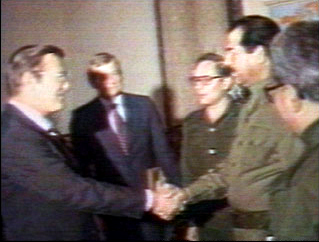
Donald Rumsfeld and Saddam Hussain - 1980's
“Modern warfare particularly depends on oil, because virtually all weapons systems rely on oil-based fuel - tanks, trucks, armored vehicles, self-propelled artillery pieces, airplanes, and naval ships. For this reason, the governments and general staffs of powerful nations seek to ensure a steady supply of oil during wartime, to fuel oil-hungry military forces in far-flung operational theaters.”

“Just as governments like the US and UK need oil companies to secure fuel for their global war-making capacity, so the oil companies need their governments to secure control over global oilfields and transportation routes. It is no accident, then, that the world’s largest oil companies are located in the world’s most powerful countries.”

“Almost all of the world’s oil-producing countries have suffered abusive, corrupt and undemocratic governments and an absence of durable development. Indonesia, Saudi Arabia, Libya, Iraq, Iran, Angola, Colombia, Venezuela, Kuwait, Mexico, Algeria - these and many other oil producers have a sad record, which includes dictatorships installed from abroad, bloody coups engineered by foreign intelligence services, militariization of government and intolerant right-wing nationalism.”

Iraq, in particular, has been the scene of a number of wars motivated by the West’s thirst for oil. During World War I, 1914-1918, the British captured the area (then known as Mesopotamia) from the Ottoman Empire after four years of bloody fighting. Although Lord Curzon denied that the British conquest of Mesopotamia was motivated by oil, there is ample evidence that British policy was indeed motivated by a desire for control of the region’s petroleum. For example, Curzon’s Cabnet colleague Sir Maurice Hankey stated in a private letter that oil was “a first-class war aim”. Furthermore, British forces continued to fight after the signing of the Murdos Armistice. In this way, they seized Mosul, the capital of a major oil-producing region, thus frustrating the plans of the French, who had been promised the area earlier in the secret Sykes-Picot Agreement.

Lord Curzon was well aware of the military importance of oil, and following the end of the First World War he remarked: “The Allied cause has floated to victory on a wave of oil”. More


Monday, August 27, 2012

Energy expert says world's oil production has peaked

Every year in August there is a weeklong event, the Oil & Gas Conference. It’s in Denver and draws an international audience. By most accounts EnerCom is the best on the schedule.

This year 121 companies were scheduled to make presentations. If I were allowed to hear only one presentation, and attend one breakout session, I’d choose Core Labs — hands down.

“The maximum yearly oil production of the planet is taking place now!” That came from the CEO of a Netherlands-based company that has 70 offices in 50 countries worldwide. Their business is analyzing drilling results for all major companies and hundreds of smaller firms in the global energy-finding industry.

The company, Core Labs (NYSE: CLB $121), has a unique view of the big picture that few, if any, others could envision. As a byproduct of their normal business activities, CLB accumulates data about the current status of all major oil and gas basins on the planet. Annual revenues are $1 billion.

While an exploration company is drilling, CLB evaluates the rock samples and evaluates the potential of finding oil and gas below. After an oil or gas field is producing, CLB helps the well operators to extract the maximum amount of hydrocarbons from the reservoir. Information that extensive about all the major energy basins in 50 countries is a unique collection of data.

Never very bashful in the breakout session, CEO Dave Demshur readily offered his thoughts about the big energy picture. When queried about predictions of increased oil availability he took the under in most cases. Basically he looks for flat, or lower, future oil generation from Mexico, Iraq, Iran, North Sea, Russia, and the shocker Saudi Arabia. More


Friday, August 17, 2012

U.S. Reliance on Oil From Saudi Arabia Is Growing Again

HOUSTON — The United States is increasing its dependence on oil from Saudi Arabia, raising its imports from the kingdom by more than 20 percent this year, even as fears of military conflict in the tinderbox Persian Gulf region grow.

The increase in Saudi oil exports to the United States began slowly last summer and has picked up pace this year. Until then, the United States had decreased its dependence on foreign oil and from the Gulf in particular.

This reversal is driven in part by the battle over Iran’s nuclear program. The United States tightened sanctions that hampered Iran’s ability to sell crude, the lifeline of its troubled economy, and Saudi Arabia agreed to increase production to help guarantee that the price did not skyrocket. While prices have remained relatively stable, and Tehran’s treasury has been squeezed, the United States is left increasingly vulnerable to a region in turmoil.

The jump in Saudi oil production has been welcomed by Washington and European governments, but Saudi society faces its own challenges, with the recent deaths of senior members of the royal family and sectarian strife in the eastern part of the country, making the stability of Saudi energy and political policies uncertain.

The United States has had a political alliance with the Saudi leadership that has lasted for decades, one that has become even more pivotal to Washington during the turmoil of the Arab spring and rising hostilities with Iran over that nation’s nuclear program. (Saudi Arabia and Iran are bitter regional rivals.)

The development underscores how difficult it is for the United States to lower its dependence on foreign oil — especially the heavy grades of crude that Saudi Arabia exports — even as domestic oil production is soaring. It is a development that has alarmed conservative and liberal foreign policy experts alike, especially with oil prices and Mideast tensions rising in recent weeks.

“At a time when there is a rising chance of either a nuclear Iran or an Israeli strike on Iran’s nuclear facilities, we should be trying to reduce our reliance on oil going through the Strait of Hormuz and not increasing it,” said Michael Makovsky, a former Defense Department official who worked on Middle East issues in the George W. Bush administration.

Senior Iranian officials have repeatedly threatened to close the Strait of Hormuz, the narrow neck through which most Gulf oil is shipped, and the Iranian navy has held maneuvers to back up the threats. Most analysts say it is doubtful the Iranians would take such an extreme measure because that would block exports vital to the country’s economy, but the United States Navy has been preparing for such a contingency. More