Showing posts with label sanctions. Show all posts

Monday, March 11, 2013

Are sanctions against Iran legal? Or are they collective punishment?

Iran, Pakistan Begin Border Gas Pipe Amid Sanctions Threat

The presidents of Pakistan and Iran inaugurated work on the cross-border leg of a gas pipeline that the U.S. has warned may breach a sanctions regime aimed at curbing the Persian Gulf nation’s nuclear program.

Pakistan’s benchmark KSE 100 share index plunged 2.5 percent in Karachi, the biggest drop in almost two months, as the news sparked concerns the U.S. would impose penalties.

Asif Ali Zardari, on his second trip to Iran within a month, joined Iran’s Mahmoud Ahmadinejad and the country’s Oil Minister Rostam Qasemi in the southern port city of Chabahar for the ground-breaking ceremony, Pakistan state television showed. The leaders offered a prayer for the project’s success and uncovered a plaque at the construction site.

Once completed, the 1,931-kilometer (1,200-mile) natural gas pipeline would help alleviate the energy crisis in Pakistan, where 18-hour blackouts last summer forced factories to close and triggered street protests. Iran is under U.S. and European Union restrictions over its atomic activities, measures that have curbed oil exports and complicated the repatriation of cash from crude sales.

Pakistan’s decision to proceed with the $1.3 billion energy link comes amid a bid to repair relations with the U.S., the South Asian nation’s biggest aid donor, after damaging setbacks including the killing of Osama bin Laden by American commandos in Pakistan in 2011 and a cross-border U.S. airstrike that killed 24 Pakistani soldiers. The U.S. needs Islamabad’s support as it withdraws combat forces from Afghanistan.

Oil Refinery

Ahmadinejad attacked opponents of the pipeline in a speech at the ceremony, drawing parallels between Iran and Pakistan.

“Foreigners are seeking to create divisions between nations in the region in order to control them and rob them of their wealth,” he said. “The only way for regional nations to safeguard their independence, identity, culture and wealth is through cooperation and unity.”

Iran has completed 900 kilometers of the pipeline on its side of the border, according to the website of Pakistan’s Interstate Gas Systems Pvt. Ltd., which will oversee construction in Pakistan. Under an accord signed in June 2010, Iran will provide about 21.5 million cubic meters of gas a day to Pakistan for 25 years. The deal can be extended by five years and volumes may rise to 30 million cubic meters a day.

The two countries are also expected to sign an agreement today to build a $4 billion oil refinery in Pakistan’s Gwadar, the state-run Press TV news channel reported.

‘Serious Concerns’

Work on extending the pipeline into Pakistan has been delayed by difficulties in arranging funding. The ground- breaking ceremony comes just days before Pakistan’s government, headed by Zardari’s party, is to hand over power to a caretaker administration ahead of parliamentary elections in May. The president’s term expires in September.

The U.S., which has offered to help Pakistan secure gas via an alternate route from Central Asia, has recently reiterated its concerns over the pipeline.

“If this deal is finalized for a proposed Iran-Pakistan pipeline, it would raise serious concerns under our Iran Sanctions Act,” Victoria Nuland, U.S. State Department spokeswoman, told a weekly briefing in Washington March 7. The U.S. hopes Pakistani won’t “go in a direction that would cause sanctions to kick in,” Nuland said, according to a transcript posted on the State Department website.

While Pakistan is aware of concerns in Washington, “all our friends including the U.S.” should show greater understanding of the country’s energy needs, Pakistan Foreign Office spokesman Moazzam Ahmad Khan told reporters March 7. More


Fourth Geneva Convention, Part 111, Article 32- 33

Art. 32. The High Contracting Parties specifically agree that each of them is prohibited from taking any measure of such a character as to cause the physical suffering or extermination of protected persons in their hands. This prohibition applies not only to murder, torture, corporal punishments, mutilation and medical or scientific experiments not necessitated by the medical treatment of a protected person, but also to any other measures of brutality whether applied by civilian or military agents.


Art. 33. No protected person may be punished for an offence he or she has not personally committed. Collective penalties and likewise all measures of intimidation or of terrorism are prohibited.


Pillage is prohibited.


Reprisals against protected persons and their property are prohibited.


http://www.icrc.org/ihl.nsf/full/380


Under the 1949 Geneva Conventions collective punishments are a war crime. By collective punishment, the drafters of the Geneva Conventions had in mind the reprisal killings of World Wars I and World War II. In the First World War, Germans executed Belgian villagers in mass retribution for resistance activity. In World War II, the Nazis carried out a form of collective punishment to suppress resistance. Entire villages or towns or districts were held responsible for any resistance activity that occured in them. Additional concern also addressed the United States' atomic bombings of Hiroshima and Nagasaki at the war's end, which, in turn, caused death and disease to hundreds of thousands of Japanese civilians.[3] The conventions, to counter this, reiterated the principle of individual responsibility. The International Committee of the Red Cross (ICRC) Commentary to the conventions states that parties to a conflict often would resort to "intimidatory measures to terrorize the population" in hopes of preventing hostile acts, but such practices "strike at guilty and innocent alike. They are opposed to all principles based on humanity and justice."


It could therefore be argued that sanctions are a type of economic warfare, in which case the Geneva Conventions should apply. Therefore, the Fourth Geneva Convention, Part 111, Article 33 would apply, prohibiting any measure to cause physical suffering to Protected Persons. Editor


Friday, March 8, 2013

The Deepening Iran-Pakistan Petro-Relationship

The Iran-Pakistan branch of the Iran-Pakistan-India gas pipeline (IPI) seems to be coming online. Pakistani President Asif Ali Zardari has announced he will visit Iran for the groundbreaking of the Pakistan branch of a new gas pipeline on March 11. It will be his second visit to Iran in less than a month, part of a deepening petro-relationship that is worrying the United States.

The pipeline is controversial, to say the least, in the US. The State Department has threatened Pakistan with sanctions for dealing with the regime in Iran, offering a electrification projects to replace any sort of benefit Pakistan would get from the petro-deal.

The challenge facing Islamabad is that it is next door to Iran, while the U.S. is not. In the long-run, it is not in their interest to remain at loggerheads with Tehran even if the U.S. wants them to be. In his press statements, foreign ministry spokesman Moazzam Ahmad Khan has been open about this. “Yes, we know about their concerns but hope our friends, including the US, will understand our economic compulsions,” said Khan.

Iran has already proposed building a new oil refinery near the Pakistani port of Gwadar.

The Pakistan-Iran pipeline is separate from a larger regional project to link India with the natural gas fields of Turkmenistan through Afghanistan and Pakistan (the so-called TAPI pipeline, or Trans-Afghanistan pipeline) . It is a goal that has been lurking in the back rooms of the energy industry since the 1990s: how can one efficiently extract and export the vast energy wealth of the Caspian region without going through Russia or China?

Two decades ago Argentina-based Bridas and Texas-based Unocal were in bitter competition for who would get the Taliban’s permission to build a pipeline across Afghanistan. Bridas came close to signing a deal, but pulled out a year later. Unocal actually brought a Taliban delegation to visit the Texas homes of its executives. Unocal eventually pulled out when the Taliban made unreasonable demands.998, Unocal also pulled out when crashed oil prices combined with international opprobrium over the Taliban’s human rights record and terrorism made the deal too difficult to finalize.

The Asia Development Bank has been pushing TAPI for years, though the insecurity in Afghanistan remains a constant barrier to anything concrete coming to pass.

While TAPI languishes in development hell, Pakistan and Iran have pushed forward with their own pipeline.From Iran’s perspective, anything that gives them an economic connection with the region and is outside the regulatory reach of the U.S. government is a boon. From Pakistan’s perspective, too, the prospect of getting income and energy without U.S. strings attached is deeply attractive. More


Monday, February 20, 2012

Expert: Attack on Iran may mean $200 / barrel oil

CBS News - An Israeli air strike on Iran, with the intent of knocking out that country's nuclear facilities, may only speed Tehran's race to build a bomb, a nuclear policy expert told CBS News.

The comments come as U.S. National Security Adviser Tom Donilon was visiting Israel to voice America's concerns over the prospect of an Israeli attack, as worry over the Islamic Republic's nuclear program mounts.

U.S. official to discuss Iran concerns in Israel

On "CBS This Morning," Joseph Cirincione, a nuclear policy expert, State Department adviser and member of the Council on Foreign Relations, said that it is uncertain whether an Israeli strike involving at least 100 aircraft would fail to stop Iran's nuclear program.

"This would be a very large and complicated and uncertain adventure," Cirincione told Charlie Rose. "They'd have to dodge a pretty stout Iran air defense network, and if they did hit the targets, as they probably could, it's uncertain whether they would do enough damage to actually do much more than delay the program for a year or so."

Cirincione seconded comments made by Gen. Martin Dempsey, the Chairman of the Joint Chiefs, that an Israeli strike would be destabilizing.

"It wouldn't be a quick end to this crisis; it would be the beginning of either a larger war or a long-scale, large-scale containment effort to try to stop Iran from what they would undoubtedly do, which would be race to build a bomb.

"And during this you would see oil prices which are already spiking probably go through the roof. Experts warn that oil could hit $200 a barrel - some even think $300 a barrel. That would have repercussions on an already fragile global economy." More


Monday, February 13, 2012

Three Major Journals Publish Articles On Limited World Oil Supply

 In the past month, three major peer-reviewed journals have published articles relating to limited world oil supply:

  1. In ScienceTechnology is Turning U. S. Oil Around But Not the World’s, by Richard A. Kerr;
  2. In NatureClimate Policy: Oil’s Tipping Point has Passed, by James Murray and David King; and
  3. In EnergyOil Supply Limits and the Continuing Financial Crisis, by Gail Tverberg.
The fact that these articles have been published is significant, because articles in the  mainstream press, such as Bloomberg’s recent article, Peak Oil Scare Fades as Shale Deepwater Wells Gush Crude, seem to suggest that our oil problems are past. While the US oil supply situation may be a little better, the world supply situation is still very bad, and oil prices are still very high around the world.
Furthermore, high oil prices tend to have a recessionary effect, and can lead to debt defaults. These issues are described in both the second and third articles above. Thus, there is a substantial chance that high oil prices are contributing to the debt default problem in Europe, and to forecast low world economic growth.
In this post, I briefly describe these articles.
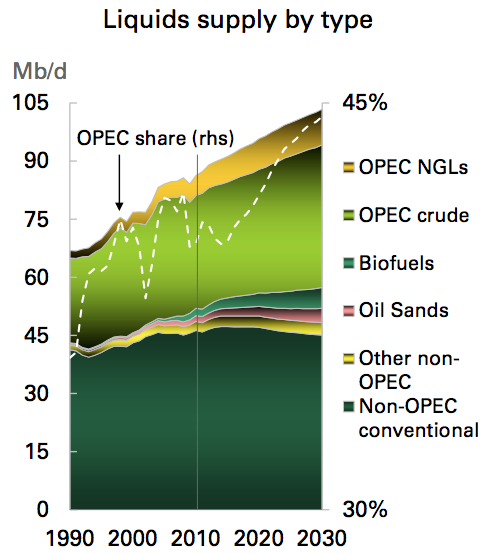
This article points out that even the optimistic estimates, such as BP’s recent Energy Outlook to 2030, see little growth in non-OPEC conventional oil production between now and 2030 (Figure 1).
Figure 1. BP oil forecast to 2030, from BP Energy Outlook to 2030

Wednesday, January 11, 2012

The Peak Oil Crisis: Gasoline in 2012

 In recent days there has been much discussion in the press about what might happen to gasoline prices in the coming year.

Cognizant of the fact that retail gasoline is currently running nearly 30 cents per gallon higher than it was in January 2008 the year when prices topped out at a national average of $4.11 and that gasoline futures have risen by 30 cents a gallon in the last few weeks, there is reason for concern. Typical of the stories is one from the Los Angeles Times that quotes Tom Kloza, long-time chief analyst for the Oil Price Information Service and the go-to guy when one needs numbers and forecasts on gasoline prices.

Kloza notes that for the last decade gasoline futures prices, which ultimately determine pump prices, have risen from an autumn low to a spring high by an average of 83 percent. During these years, the annual winter-spring price surge has varied anywhere from 52 to 169 percent making higher prices by summer a fairly sure bet. This year the 2011 low for gasoline on the NY futures market likely will turn out to have been $2.44 a gallon on November 25. If one does the arithmetic using the average price jump of 83 percent, futures prices could be expected to top out in the vicinity of $4.46 a gallon next spring. Adding in the additional 60 cents to get the gasoline taxed and to the nozzle of your pump, we could theoretically be paying a national average on the order of $5.00 a gallon before the 4th of July. This of course assumes that nothing bad happens in the Middle East that restricts or seriously threatens the flow of oil exports and sends prices much higher.

The $5 scenario is too much for Kloza so he settles for a fall-to-spring increase of only 40-45 percent this year which has pump prices topping out between $3.90 and $4.25 a gallon. An increase of only 40-45 percent, of course, would be the smallest winter-spring price rally in this century, but $4 a gallon is something the average American has seen before and can comprehend - forecasting $5 gasoline for six months from now is simply not acceptable considering the economic and political havoc it would be likely to cause. More


Tuesday, January 10, 2012

Energy Wars 2012

 Last week, the president made a rare appearance at the Pentagon to unveil a new strategic plan for U.S. military policy (and so spending) over the next decade. 

 Let’s leave the specifics to a future TomDispatch post and focus instead on a historical footnote: Obama was evidently the first president to offer remarks from a podium in the Pentagon press room. He made the point himself -- “I understand this is the first time a president has done this. It’s a pretty nice room. (Laughter)” -- and it was duly noted in the media. Yet no one thought to make anything of it, even though it tells us so much about our American world.After all, when was the last time the president appeared at a podium at the Environmental Protection Agency to announce a 10-year plan for a “leaner, meaner” approach to the environment, or at the Education Department to outline the next decade of blue-skies thinking (and spending) for giving our children a leg-up in a competitive world? Or how about at a State Department podium to describe future planning for a more peaceable planet more peaceably attained?

 Unfortunately, you can’t remember such moments and neither can America’s reporters, because they just aren’t part of Washington life. And strangest of all, no one finds this the tiniest bit odd or worth commenting on. Over the last decade, this country has been so strikingly militarized that no one can imagine 10 years of serious government planning or investment not connected to the military or the national security state. It’s a dangerous world out there -- so we’re regularly told by officials who don’t mention that no military is built to handle the scariest things around. War and the sinews of war are now our business and the U.S. military is our go-to outfit of choice for anything from humanitarian action to diplomacy (even though that same military can’t do the one thing it’s theoretically built to do: win a modern war). And if you don’t believe me that the militarization of this country is a process far gone, check out the last pages of Secretary of State Hillary Clinton’s recent piece, “America’s Pacific Century,” in Foreign Policy magazine. 

 Then close your eyes and tell me that it wasn’t written by a secretary of defense, rather than a secretary of state -- right down to the details about the “littoral combat ships” we’re planning to deploy to Singapore and the “greater American military presence” in Australia. More


Monday, January 9, 2012

The Peak Oil Crisis: Closing Out The Year

The returns are in and we now know that world price of a barrel of oil averaged $111 in 2011. This was up 14 percent from last year and well above the previous high of $100 set in 2008.

The average barrel of oil that we bought last year cost $15 more than the year before. Here in America, we burn about 6.7 billion barrels of the stuff each year. Therefore, our collective oil bill for 2011 was about $100 billion higher for the same amount of energy that we burned in 2010. This $100 billion created few new jobs here in the USA. Much of it went overseas and into the coffers of people who don't like us very much. 

Last year's news was dominated by the Arab spring and its derivatives which spread from Wall Street, to Moscow, to villages in China as the revolution in communications technology coalesced in the hands of a new generation making dissidence against governments everywhere far easier to organize. By the way, the latest count of cell phones shows that in excess of 5 billion have been produced. Not all of these are still active, of course, but for a world of 7 billion people, many of whom are too young to talk much less carry a mobile phone, that is an impressive number. It is clear the world is changing in ways we cannot yet comprehend.

The peak oil story changed little last year. Global oil production hung in around 88 million barrels a day (b/d) despite the Libyan uprising which took nearly 1.6 million b/d out of production for several months. For much of last year global oil production was below consumption resulting in a gradual drawdown of world reserves. With OECD stockpiles of about 2.6 billion barrels, plus the new reserves being accumulated in China, a slight shortfall in production is not a problem for the time being. More

Saturday, January 7, 2012

Iran oil ban could herald economic disaster for Europe

Oil prices could spiral out of control and potentially herald deeper economic hardship for Europe if the European Union joins the U.S. Oil prices could spiral out of control and potentially herald deeper economic hardship for Europe if the European Union joins the U.S.in banning Iranian oil imports, analysts warned.

EU officials said on Wednesday that European governments agreed in principle to ban imports of Iranian oil. 

But several countries within the EU are heavily reliant on oil imports from Iran, and none more so than economically struggling Greece, which currently imports 30 percent of its domestic oil from the country, according to the International Energy Agency (IEA). 

Greece to collapse 

Greece’s economy is already mired in deep recession and could feasibly collapse entirely if the sanctions were imposed, Paul Stevens, economist and emeritus professor at Dundee University in Scotland, told CNBC.

Were that to happen, the Greek economy could take its European neighbors down with it. But the likelihood would be that Greece would have to ignore the import ban and that the EU would have to allow it to in order to avert economic disaster.

“Let’s assume the European Union is stupid enough to go along with the U.S. in imposing sanctions on Iran. That would only mean 250,000 barrels of heavy sour oil not coming into the EU,” Stevens said. More