Showing posts with label European Union. Show all posts

Tuesday, February 21, 2012

Chart of the week: oil dependency


The price of Brent crude oil hit an eight-month high last week, and is currently trading at more than $120 per barrel as fears escalated that Iran, the world’s third-largest oil exporter, could cut its exports to the European Union.

How much do emerging markets depend on oil for their energy – and who wins and who loses from high oil prices? Chart of the week investigates.

More


Monday, February 20, 2012

Expert: Attack on Iran may mean $200 / barrel oil

CBS News - An Israeli air strike on Iran, with the intent of knocking out that country's nuclear facilities, may only speed Tehran's race to build a bomb, a nuclear policy expert told CBS News.

The comments come as U.S. National Security Adviser Tom Donilon was visiting Israel to voice America's concerns over the prospect of an Israeli attack, as worry over the Islamic Republic's nuclear program mounts.

U.S. official to discuss Iran concerns in Israel

On "CBS This Morning," Joseph Cirincione, a nuclear policy expert, State Department adviser and member of the Council on Foreign Relations, said that it is uncertain whether an Israeli strike involving at least 100 aircraft would fail to stop Iran's nuclear program.

"This would be a very large and complicated and uncertain adventure," Cirincione told Charlie Rose. "They'd have to dodge a pretty stout Iran air defense network, and if they did hit the targets, as they probably could, it's uncertain whether they would do enough damage to actually do much more than delay the program for a year or so."

Cirincione seconded comments made by Gen. Martin Dempsey, the Chairman of the Joint Chiefs, that an Israeli strike would be destabilizing.

"It wouldn't be a quick end to this crisis; it would be the beginning of either a larger war or a long-scale, large-scale containment effort to try to stop Iran from what they would undoubtedly do, which would be race to build a bomb.

"And during this you would see oil prices which are already spiking probably go through the roof. Experts warn that oil could hit $200 a barrel - some even think $300 a barrel. That would have repercussions on an already fragile global economy." More

 

Monday, February 13, 2012

Three Major Journals Publish Articles On Limited World Oil Supply

 In the past month, three major peer-reviewed journals have published articles relating to limited world oil supply:

  1. In ScienceTechnology is Turning U. S. Oil Around But Not the World’s, by Richard A. Kerr;
  2. In NatureClimate Policy: Oil’s Tipping Point has Passed, by James Murray and David King; and
  3. In EnergyOil Supply Limits and the Continuing Financial Crisis, by Gail Tverberg.
The fact that these articles have been published is significant, because articles in the  mainstream press, such as Bloomberg’s recent article, Peak Oil Scare Fades as Shale Deepwater Wells Gush Crude, seem to suggest that our oil problems are past. While the US oil supply situation may be a little better, the world supply situation is still very bad, and oil prices are still very high around the world.
Furthermore, high oil prices tend to have a recessionary effect, and can lead to debt defaults. These issues are described in both the second and third articles above. Thus, there is a substantial chance that high oil prices are contributing to the debt default problem in Europe, and to forecast low world economic growth.
In this post, I briefly describe these articles.
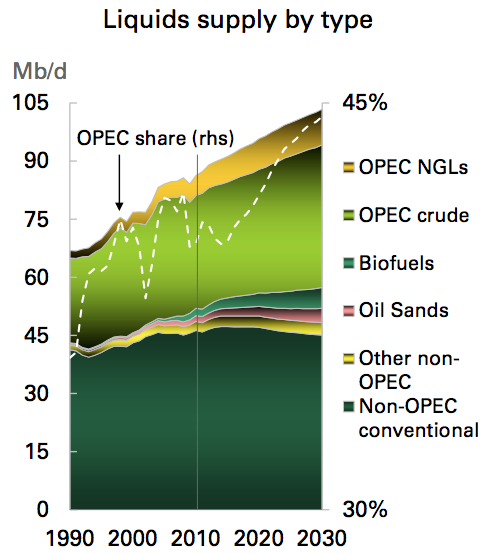
This article points out that even the optimistic estimates, such as BP’s recent Energy Outlook to 2030, see little growth in non-OPEC conventional oil production between now and 2030 (Figure 1).
Figure 1. BP oil forecast to 2030, from BP Energy Outlook to 2030

Monday, January 23, 2012

Iran 'Definitely' Closing Strait of Hormuz Over EU Oil Embargo

 January 23, 2011 '"RT" --Tensions in the Gulf could reach a breaking point as a senior Iranian official said Iran would “definitely” close the Strait of Hormuz if an EU oil embargo disrupted the export of crude oil.

Mohammad Kossari, deputy head of parliament's foreign affairs and national security committee, issued the warning in respone to a decision by the European Union on Monday to impose an oil embargo on Iran over the country’s alleged nuclear weapons program. 

“The pressure of sanctions is designed to try and make sure that Iran takes seriously our request to come to the table,” EU foreign policy chief Catherine Ashton said.

However, with Washington’s decision to deploy a second carrier strike group in the Gulf, the EU’s attempt to pressure Iran economically could greatly increase the likelihood of all-out war in the region.

The Strait of Hormuz is the vital link between the Persian Gulf and the Gulf of Oman.

It is also one of the most strategic chokepoints in the world when it comes to oil transit.

With world oil output estimated at some 88 million barrels per day in 2011, the US Energy Information Administration estimated that some 17 million of those barrels passed through the Strait.

If economic sanctions sufficiently pressure Iran to retaliate by closing down the Strait, nearly 20 per cent of worldwide oil trade would be impacted, resulting in a massive spike in global energy costs.

With over half a million regular forces and an additional 120,000 personnel in the country’s elite Revolutionary Guard, analysts believe the consequences of a US-led war against Iran would dwarf recent Western-backed military incursions the Middle East. 

Thus far, the US decision to maintain two carrier strike groups in the region has been described as “a routine activity” by Iran. 

But the vast US military buildup in the region, which was bolstered when the Pentagon dispatched an additional 15,000 troops to the neighboring nation of Kuwait, was only the latest step in an obvious attempt by Washington to strengthen its military capabilities in the region. More
 

Saturday, January 21, 2012

Australian Peak Oil Report Released

Transport energy futures:long-term oil supply trends and projections
Report 117 
Foreword

In 2007 the Bureau of Infrastructure, Transport and Regional Economics (BITRE)commenced a project to look in a strategic way at possible alternative transportenergy futures.
This was driven by a perceived need to address two key challenges to ‘business-as-usual’ for Australian and world transport: oil depletion and global warming.
To examine the oil depletion issue, it was necessary to assemble large amounts ofdata over long periods of time (centuries in a large number of cases). BITRE has hadlong experience with assembling lengthy datasets from multiple and sometimesconflicting data sources, and then analysing their dynamics. This is what has beendone here, to examine the oil production prospects of over 40 countries/regionsaround the world, as a preliminary to delineating the scope of the oil depletionchallenge.
Recognising that the issue of the timing of oil depletion is a highly controversialarea, where information can be contested and where there is a range of views andpositions, comments are expressly invited on this report.
Future reports will examine 1) world oil demand/price relationships and 2) the kindsof responses to the twin challenges of oil depletion and global warming that may bepossible in terms of alternative fuels and propulsion technologies. More
Report in PDF
 

Monday, January 9, 2012

The Peak Oil Crisis: Closing Out The Year

The returns are in and we now know that world price of a barrel of oil averaged $111 in 2011. This was up 14 percent from last year and well above the previous high of $100 set in 2008.

The average barrel of oil that we bought last year cost $15 more than the year before. Here in America, we burn about 6.7 billion barrels of the stuff each year. Therefore, our collective oil bill for 2011 was about $100 billion higher for the same amount of energy that we burned in 2010. This $100 billion created few new jobs here in the USA. Much of it went overseas and into the coffers of people who don't like us very much. 

Last year's news was dominated by the Arab spring and its derivatives which spread from Wall Street, to Moscow, to villages in China as the revolution in communications technology coalesced in the hands of a new generation making dissidence against governments everywhere far easier to organize. By the way, the latest count of cell phones shows that in excess of 5 billion have been produced. Not all of these are still active, of course, but for a world of 7 billion people, many of whom are too young to talk much less carry a mobile phone, that is an impressive number. It is clear the world is changing in ways we cannot yet comprehend.

The peak oil story changed little last year. Global oil production hung in around 88 million barrels a day (b/d) despite the Libyan uprising which took nearly 1.6 million b/d out of production for several months. For much of last year global oil production was below consumption resulting in a gradual drawdown of world reserves. With OECD stockpiles of about 2.6 billion barrels, plus the new reserves being accumulated in China, a slight shortfall in production is not a problem for the time being. More

Saturday, January 7, 2012

Iran oil ban could herald economic disaster for Europe

Oil prices could spiral out of control and potentially herald deeper economic hardship for Europe if the European Union joins the U.S. Oil prices could spiral out of control and potentially herald deeper economic hardship for Europe if the European Union joins the U.S.in banning Iranian oil imports, analysts warned.

EU officials said on Wednesday that European governments agreed in principle to ban imports of Iranian oil. 

But several countries within the EU are heavily reliant on oil imports from Iran, and none more so than economically struggling Greece, which currently imports 30 percent of its domestic oil from the country, according to the International Energy Agency (IEA). 

Greece to collapse 

Greece’s economy is already mired in deep recession and could feasibly collapse entirely if the sanctions were imposed, Paul Stevens, economist and emeritus professor at Dundee University in Scotland, told CNBC.

Were that to happen, the Greek economy could take its European neighbors down with it. But the likelihood would be that Greece would have to ignore the import ban and that the EU would have to allow it to in order to avert economic disaster.

“Let’s assume the European Union is stupid enough to go along with the U.S. in imposing sanctions on Iran. That would only mean 250,000 barrels of heavy sour oil not coming into the EU,” Stevens said. More