Showing posts with label heating. Show all posts

Tuesday, October 29, 2013

Long, cold winter for 3 million who can’t pay their energy bills

Three million elderly people fear they will not be able to stay warm in their own homes this winter, following the recent steep increases in the cost of heating, according to research published today.

The plight of many older householders emerged as the Government faced renewed calls to offer immediate help to lower-income families struggling to pay energy bills. Four of the “Big Six” energy companies have raised their prices before the winter surge in demand, with the average combined electricity and gas bill now standing at £1,267 per year.

Executives from the firms, which have been accused of acting as a cartel, will appear before MPs tomorrow to defend the sharp rises. Yesterday their trade organisation dismissed calls for a windfall tax on the Big Six, insisting their profits were not “particularly big”.

Over the weekend it also emerged that energy companies have been using tax loopholes. Although he declined to comment on individual companies, Danny Alexander, the Chief Secretary to the Treasury, said yesterday: “People are rightly livid about companies and individuals avoiding paying the proper amount of tax. I’m livid about that. It is something which is not acceptable at any time, but particularly at a time when we’re going through tough spending choices.”

He was speaking after The Independent on Sunday reported that three companies – Scotia Gas, UK Power Networks and Electricity Northwest – had saved £140m between them by using legal tax loopholes to minimise their liabilities. With gas and electricity prices continuing to dominate exchanges between political leaders, a survey for Age UK found that 28 per cent of pensioners said their main concern for the coming cold months was ensuring they could heat their homes. The charity said the figures suggested the problems could affect as many as three million older people across the UK.

Age UK also raised the alarm over the health dangers to the elderly people, warning that cold weather and poorly heated homes increased the risk not only of influenza but also of heart attack and stroke. There are about 24,000 excess deaths in a typical British winter, many of them preventable.

Age UK said more than 40 per cent were caused by heart attack or stroke. Caroline Abrahams, the charity’s director, said: “It’s vital for older people to keep warm, both inside and outside their homes in the winter months. Being cold, even for just a short amount of time, can be very dangerous, as it increases the risk of associated health problems and preventable deaths during the winter.”

Senior executives from the Big Six will be challenged to justify the recent price hikes when they appear before the Commons Energy and Climate Change Select Committee. Simon Hughes, the Deputy Liberal Democrat leader, said Chancellor George Osborne should use the Autumn Statement in December to announce emergency help for families struggling with bills.

“I would like people to have a rebate on energy bills that would help the poorest most and would mean that there would be immediate relief this year, not waiting for the post-election period,” he told BBC1’s Sunday Politics.

Ed Miliband, the Labour leader, has said an incoming Labour government would force energy firms to freeze their prices for 19 months, while the former Tory Prime Minister Sir John Major has called for a levy on their profits.

But Angela Knight, chief executive of Energy UK, which represents the companies, said their profits were not large enough to justify a windfall tax. “The profits here are, what, four to five per cent, four or five pence in the pound. That isn’t particularly big,” she said. She added that the companies were also making large investments in the UK and therefore had to have an “operating margin”.

The Government has invested an extra £500m in A&E services in a bid to avoid another winter crisis on emergency wards. A&E units have been under increased pressure for several months. MPs warned in the summer that the system may struggle to cope in the event of a major winter flu pandemic.

Dr Paul Cosford, director for health protection and medical director at Public Health England (PHE), said: “In colder weather, keeping yourself warm is essential to staying healthy, especially for the very young, older people or those with a chronic condition such as heart disease and asthma. There are a range of health problems associated with cold housing and winter weather, but, in particular, a cold indoor or outdoor environment can make heart and respiratory problems worse and can be fatal.”

PHE said living-room temperatures should ideally be kept at 70F (21C) and above, whereas bedroom temperatures should be kept at a minimum of 64F (18C).

Health leaders have also urged all at-risk groups – including the over-65s – to have a flu vaccination.

PHE will work with the Met Office between 1 November and 31 March 2014. Low temperatures of 2C or less or a spell of heavy snow will trigger cold weather alerts, which require hospitals, social care systems and GP surgeries to ensure they are prepared for spikes in demand. More


Monday, January 23, 2012

Iran 'Definitely' Closing Strait of Hormuz Over EU Oil Embargo

 January 23, 2011 '"RT" --Tensions in the Gulf could reach a breaking point as a senior Iranian official said Iran would “definitely” close the Strait of Hormuz if an EU oil embargo disrupted the export of crude oil.

Mohammad Kossari, deputy head of parliament's foreign affairs and national security committee, issued the warning in respone to a decision by the European Union on Monday to impose an oil embargo on Iran over the country’s alleged nuclear weapons program. 

“The pressure of sanctions is designed to try and make sure that Iran takes seriously our request to come to the table,” EU foreign policy chief Catherine Ashton said.

However, with Washington’s decision to deploy a second carrier strike group in the Gulf, the EU’s attempt to pressure Iran economically could greatly increase the likelihood of all-out war in the region.

The Strait of Hormuz is the vital link between the Persian Gulf and the Gulf of Oman.

It is also one of the most strategic chokepoints in the world when it comes to oil transit.

With world oil output estimated at some 88 million barrels per day in 2011, the US Energy Information Administration estimated that some 17 million of those barrels passed through the Strait.

If economic sanctions sufficiently pressure Iran to retaliate by closing down the Strait, nearly 20 per cent of worldwide oil trade would be impacted, resulting in a massive spike in global energy costs.

With over half a million regular forces and an additional 120,000 personnel in the country’s elite Revolutionary Guard, analysts believe the consequences of a US-led war against Iran would dwarf recent Western-backed military incursions the Middle East. 

Thus far, the US decision to maintain two carrier strike groups in the region has been described as “a routine activity” by Iran. 

But the vast US military buildup in the region, which was bolstered when the Pentagon dispatched an additional 15,000 troops to the neighboring nation of Kuwait, was only the latest step in an obvious attempt by Washington to strengthen its military capabilities in the region. More
 

Saturday, January 21, 2012

Australian Peak Oil Report Released

Transport energy futures:long-term oil supply trends and projections
Report 117 
Foreword

In 2007 the Bureau of Infrastructure, Transport and Regional Economics (BITRE)commenced a project to look in a strategic way at possible alternative transportenergy futures.
This was driven by a perceived need to address two key challenges to ‘business-as-usual’ for Australian and world transport: oil depletion and global warming.
To examine the oil depletion issue, it was necessary to assemble large amounts ofdata over long periods of time (centuries in a large number of cases). BITRE has hadlong experience with assembling lengthy datasets from multiple and sometimesconflicting data sources, and then analysing their dynamics. This is what has beendone here, to examine the oil production prospects of over 40 countries/regionsaround the world, as a preliminary to delineating the scope of the oil depletionchallenge.
Recognising that the issue of the timing of oil depletion is a highly controversialarea, where information can be contested and where there is a range of views andpositions, comments are expressly invited on this report.
Future reports will examine 1) world oil demand/price relationships and 2) the kindsof responses to the twin challenges of oil depletion and global warming that may bepossible in terms of alternative fuels and propulsion technologies. More
Report in PDF
 

Monday, January 9, 2012

The Peak Oil Crisis: Closing Out The Year

The returns are in and we now know that world price of a barrel of oil averaged $111 in 2011. This was up 14 percent from last year and well above the previous high of $100 set in 2008.

The average barrel of oil that we bought last year cost $15 more than the year before. Here in America, we burn about 6.7 billion barrels of the stuff each year. Therefore, our collective oil bill for 2011 was about $100 billion higher for the same amount of energy that we burned in 2010. This $100 billion created few new jobs here in the USA. Much of it went overseas and into the coffers of people who don't like us very much. 

Last year's news was dominated by the Arab spring and its derivatives which spread from Wall Street, to Moscow, to villages in China as the revolution in communications technology coalesced in the hands of a new generation making dissidence against governments everywhere far easier to organize. By the way, the latest count of cell phones shows that in excess of 5 billion have been produced. Not all of these are still active, of course, but for a world of 7 billion people, many of whom are too young to talk much less carry a mobile phone, that is an impressive number. It is clear the world is changing in ways we cannot yet comprehend.

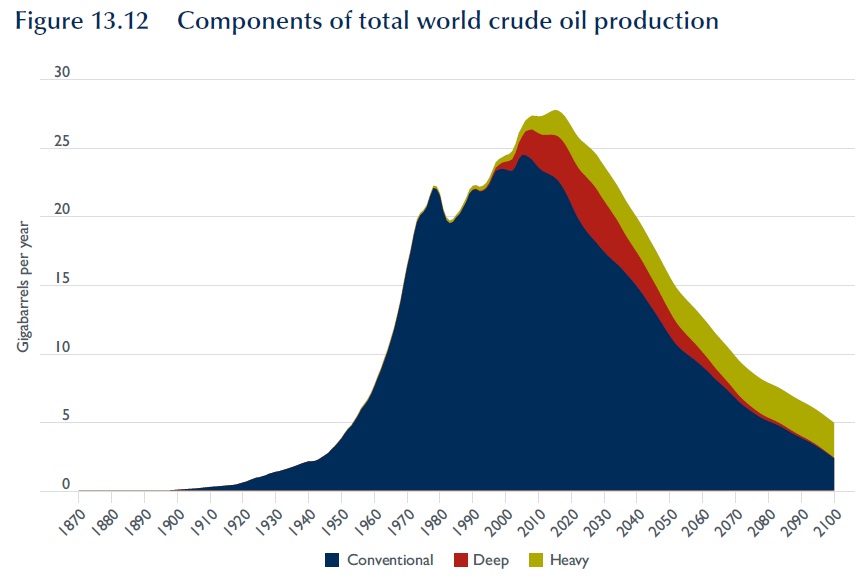
The peak oil story changed little last year. Global oil production hung in around 88 million barrels a day (b/d) despite the Libyan uprising which took nearly 1.6 million b/d out of production for several months. For much of last year global oil production was below consumption resulting in a gradual drawdown of world reserves. With OECD stockpiles of about 2.6 billion barrels, plus the new reserves being accumulated in China, a slight shortfall in production is not a problem for the time being. More

Thursday, December 22, 2011

The Peak Oil Crisis: 2012 – Apocalypse Now?

A case can be made that some very bad things might be coming in the next year or so

This would not be a biblical apocalypse or even a Mayan one, but rather an event of our own making. The world has made so many problems for itself in recent decades that the whole edifice of civilization is showing signs of coming unglued.

This sort of thing has happened within living memory - remember 1914 and 1939 - so a year in which much comes undone should not come as a great surprise. If you are looking for a general theory of what is about to happen to us, you might start with Joseph Tainter's The Collapse of Complex Societies in which the author identifies 17 examples of rapid societal collapse. In a nutshell, if anybody thinks the Roman Empire collapsed from too much complexity, one should look at the U.S. tax code or the efforts to refinance the EU's sovereign debt. Compared to the machinations of the 7 billion people currently running around the world, the Romans were running a kindergarten.

Whether the global civilization, or significant parts thereof, comes unstuck sooner or later is obviously a judgment call, but a case can be made that some very bad things might be coming in the next year or so. There would seem to be two fundamental problems behind the coming upheavals. One is that we are running into constraints on resources and the other is that the OECD nations have simply accumulated so much debt that it is unlikely to ever be repaid. No one ever thinks of the atmosphere's ability to absorb and carry off carbon emissions as a resource, but as the world's climate changes for the worse, that is exactly what it is. It could easily turn out over the course of the next 10 decades, that the atmosphere's ability to absorb greenhouse gases turns out to be far more important than reserves of fossil fuels. More

Wednesday, December 14, 2011

Harnessing the Sun's Energy for Water and Space Heating

The pace of solar energy development is accelerating as the installation of rooftop solar water heaters takes off. Unlike solar photovoltaic (PV) panels that convert solar radiation into electricity, these "solar thermal collectors" use the sun's energy to heat water, space, or both.

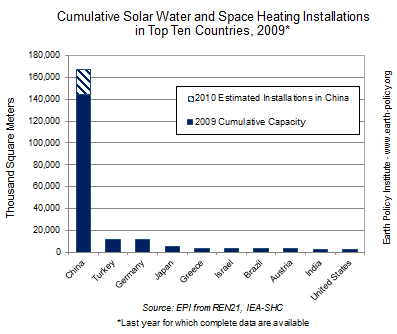
China had an estimated 168 million square meters (1.8 billion square feet) of rooftop solar thermal collectors installed by the end of 2010—nearly two thirds of the world total.  This is equivalent to 118,000 thermal megawatts of capacity, enough to supply 112 million Chinese households with hot water.  With some 5,000 Chinese companies manufacturing these devices, this relatively simple low-cost technology has leapfrogged into villages that do not yet have electricity. For as little as $200, villagers can install a rooftop solar collector and take their first hot shower. This technology is sweeping China like wildfire, already approaching market saturation in some communities. Beijing’s goal is to reach 300 million square meters of rooftop solar water heating capacity across the country by 2020, a goal it is likely to exceed. 
Other developing countries such as India and Brazil may also soon see millions of households turning to this inexpensive water heating technology. Once the initial installment cost of rooftop solar water heaters is paid back, the hot water is essentially free.

In Europe, where energy costs are relatively high, rooftop solar water heaters are also spreading fast. In Austria, 15 percent of all households now rely on them for hot water. Germany is also forging ahead. Some 2 million Germans are now living in homes with rooftop solar systems. Roughly 30 percent of the installed solar thermal capacity in these two countries consists of “solar combi-systems” that are engineered to heat both water and space.

The U.S. rooftop solar water heating industry has historically concentrated on a niche market—selling and marketing more than 9 million square meters of solar water heaters for swimming pools between 1995 and 2005. Given this base, the industry was poised to mass-market residential solar water and space heating systems when federal tax credits were introduced in 2006. Led by Hawaii, California, and Florida, annual U.S. installations of these systems have more than tripled since 2005. More