Showing posts with label water. Show all posts

Wednesday, June 11, 2014

Iraq oil shock would kill world economic recovery, experts warn

As I have been warning people about for a number of years: Potential oil price spike in Middle East; What could this do to the Cayman Islands?

Open warfare between the government and rebels in Iraq would pose a threat to the global economic recovery should oil production from the war-torn Middle East state suffer a serious disruption, analysts have warned.

As violence threatens Iraq's oil industry, experts fear crude at $130 per barrel would damage the global economy

Open warfare between the government and rebels in Iraq would pose a threat to the global economic recovery should oil production from the war-torn Middle East state suffer a serious disruption, analysts have warned.

Brent oil prices climbed as high as $110.25 (£65.59) on Wednesday amid concerns that 3.5m barrels per day of Iraqi exports could be knocked out of the market by the violence that has seen al-Qaeda forces seize control of Mosul, Tikrit and Samarra.

"The worst case scenario is that we see production from Iraq slip down to levels in the last Gulf war, then oil could spike $20 a barrel very quickly," Ole Hansen, vice-president and head of commodity strategy at Saxo Bank told The Telegraph. "In that scenario, the entire economic recovery, which is still fragile, could stall and we could even slip back into recession in some regions."

Iraq's oil minister, Abdul Kareem Luaibi, who was attending a gathering of the 12-member Organisation of Petroleum Exporting Countries (Opec) in Vienna on Wednesday, tried to ease concerns by stressing that most of the country's crude was pumped from fields in the Shia-Muslim dominated South, where export facilities are "very, very safe".

Despite the deteriorating political situation in Iraq, where government forces have been seen fleeing from the Sunni-Muslim al-Qaeda insurgents, Opec decided to leave its production quotas unchanged. The cartel limits the output of its members to 30m barrels per day (bpd) of crude, roughly a third of the world's supply.

However, the group's ability to react to shocks to the oil market is limited, with Saudi Arabia the only producer with enough spare production capacity to cover any shortfalls. Riyadh maintains about 12.5m barrles per day (bpd) of production capacity, with 2.5m bpd - three-times Britain's output from the North Sea - lying idle at any one time.

Although Saudi's oil officials told reporters in Vienna on Wednesday that the kingdom and Opec could compensate for any Iraqi shortfalls, oil traders remain concerned.

In a note to Bloomberg, Helima Croft, Barclays' head of North American commodities research, said: "The shocking escalation in violence in Iraq raises the prospect of potential output losses. It comes as other key producers, like Libya, have also seen exports 'evaporate' amid rising unrest."

Helped by investment from international oil companies such as Royal Dutch Shell, BP and Lukoil, Iraq has increased its importance in the world oil market since recovering from the 2003 war.

The opening of the giant West Qurna-2 oilfield near Basra in March would allow Iraq to pump 4m bpd by the end of the year. Already the second-largest producer in Opec after Saudi Arabia, according to Reuters, Iraq has pumped an average of 3.5m bpd since the beginning of the year.

UK oil companies working in Iraq are understood to be closely monitoring the situation but at this point have no plans to withdraw workers from their fields.

Brent oil prices climbed as high as $110.25 (£65.59) on Wednesday amid concerns that 3.5m barrels per day of Iraqi exports could be knocked out of the market by the violence that has seen al-Qaeda forces seize control of Mosul, Tikrit and Samarra.

"The worst case scenario is that we see production from Iraq slip down to levels in the last Gulf war, then oil could spike $20 a barrel very quickly," Ole Hansen, vice-president and head of commodity strategy at Saxo Bank told The Telegraph. "In that scenario, the entire economic recovery, which is still fragile, could stall and we could even slip back into recession in some regions."

Iraq's oil minister, Abdul Kareem Luaibi, who was attending a gathering of the 12-member Organisation of Petroleum Exporting Countries (Opec) in Vienna on Wednesday, tried to ease concerns by stressing that most of the country's crude was pumped from fields in the Shia-Muslim dominated South, where export facilities are "very, very safe".

Despite the deteriorating political situation in Iraq, where government forces have been seen fleeing from the Sunni-Muslim al-Qaeda insurgents, Opec decided to leave its production quotas unchanged. The cartel limits the output of its members to 30m barrels per day (bpd) of crude, roughly a third of the world's supply.

However, the group's ability to react to shocks to the oil market is limited, with Saudi Arabia the only producer with enough spare production capacity to cover any shortfalls. Riyadh maintains about 12.5m barrles per day (bpd) of production capacity, with 2.5m bpd - three-times Britain's output from the North Sea - lying idle at any one time.

Although Saudi's oil officials told reporters in Vienna on Wednesday that the kingdom and Opec could compensate for any Iraqi shortfalls, oil traders remain concerned.

In a note to Bloomberg, Helima Croft, Barclays' head of North American commodities research, said: "The shocking escalation in violence in Iraq raises the prospect of potential output losses. It comes as other key producers, like Libya, have also seen exports 'evaporate' amid rising unrest."

Helped by investment from international oil companies such as Royal Dutch Shell, BP and Lukoil, Iraq has increased its importance in the world oil market since recovering from the 2003 war.

The opening of the giant West Qurna-2 oilfield near Basra in March would allow Iraq to pump 4m bpd by the end of the year. Already the second-largest producer in Opec after Saudi Arabia, according to Reuters, Iraq has pumped an average of 3.5m bpd since the beginning of the year.

UK oil companies working in Iraq are understood to be closely monitoring the situation but at this point have no plans to withdraw workers from their fields. More

Furthermore, if the insurgencies drag Iran into the fray will Kingdom of Saudi Arabia (KSA) be tempted to respond on the side of the Wahabi / Salafi axis? Remember that KSA recently spent 60 Billion or armaments. Where may any of this leave the Cayman Islands? Editor


Sunday, June 8, 2014

US Navy Lab Turns Seawater Into Fuel


Published on May 21, 2014 • For centuries, alchemists have tried to turn lead into gold. That transmutation has long

been proven impossible, but another similar dream - turning water into fuel - seems to be achievable. Scientists at a

U.S. Naval Laboratory proved it by flying a model airplane burning re-engineered seawater. VGA'S George Putic has the story.

Monday, February 17, 2014

Will Water Constrain Our Energy Future?

Energy and water security are crucial to human and economic development. The two resources are now more interconnected than ever -- significant amounts of water are needed in almost all energy generation processes, from generating hydropower, to cooling and other purposes in thermal power plants, to extracting and processing fuels. Conversely, the water sector needs energy – mainly in the form of electricity – to extract, treat and transport water. Both energy and water are used in the production of crops, including those used to generate energy through biofuels.

But energy and water resources are under unprecedented pressure, and there is growing competition for their use from people, industries, ecosystems, and growing economies. As the world’s population reaches 9 billion, demand will require a 50 percent increase in agricultural production and a 15 percent increase in already-strained water withdrawals. By 2035, the world’s energy consumption will increase by 35 percent, which in turn will increase water use by 15 percent and consumption by 85 percent, according to the International Energy Agency.

Climate change will add more uncertainty through increased water variability and more frequent and severe floods and droughts. Energy systems are becoming ever more vulnerable to the impacts of climate change. As temperatures get warmer, so do the rivers and lakes that power plants draw their cooling water from - which makes it harder to generate electricity in the coming decades.

“We cannot meet our global energy goals of extending access to the poor, increasing efficiency and expanding renewables without water. The water energy interrelationship is critical to build resilient as well as efficient, clean energy systems. The time to act is now,” said Rachel Kyte, World Bank Group Vice President and Special Envoy for Climate Change.

Risks to the energy sector

Water scarcity is already threatening the long-term viability of energy projects worldwide. Last year alone, water shortages shut down thermal power plants in India, decreased energy production in power plants in the United States and threatened hydropower capacity in many countries, including Sri Lanka, China and Brazil. More


Thursday, October 10, 2013

ADB Releases Report on Managing the Water-Food-Energy Nexus


September 2013: The Asian Development Bank (ADB) has released a report, titled 'Thinking About Water Differently: Managing the Water-Food-Energy Nexus,' which argues for recognition of water as an economic and social good and the urgent assurance of regional water security to eliminate risk to food and energy security in Asia and the Pacific.


According to the ADB report, which offers high-level guidance on water issues affecting the region, governments need to think differently about water, taking a longer-term view of the limited resource. It highlights the importance of the following strategic approaches: reforming water governance through advocacy at global, regional, and national levels; generating reliable data and information on the availability and behavior of water resources; resource protection through effective reduction of wastewater and other waste discharging into freshwater supplies through regulation, investment, and innovation; water for food through stimulating research into improving the use of water in agriculture, increasing food production on the same area of land, and using less water; and increasing storage including via aquifer recharge, as a response to uncertainties in supply that are being aggravated by climate change. [Publication: Thinking About Water Differently: Managing the Water-Food-Energy Nexus] [ADB Press Release]


More: http://energy-l.iisd.org/news/adb-releases-report-on-managing-the-water-food-energy-nexus/


Saturday, October 5, 2013

New Report First to Quantify Damage Done by Gas Drilling

“The numbers don't lie — fracking has taken a dirty and destructive toll on our environment. If this dirty drilling continues unchecked, these numbers will only get worse,” said John Rumpler, senior attorney for Environment America.

“At health clinics, we’re seeing nearby residents experiencing nausea, headaches and other symptoms linked to fracking pollution,” said David Brown, a toxicologist who has reviewed health data from Pennsylvania. “With billions of gallons of toxic waste coming each year, we’re just seeing the ‘tip of the iceberg’ in terms of health risks.”

The “Fracking by the Numbers” report measured key indicators of fracking threats across the country, including:

• 280 billion gallons of toxic wastewater generated in 2012,
• 450,000 tons of air pollution produced in one year,
• 250 billion gallons of fresh water used since 2005,
• 360,000 acres of land degraded since 2005,
• 100 million metric tons of global warming pollution since 2005.

Fracking also inflicts other damage not quantified in the report — ranging from contamination of residential wells to ruined roads to earthquakes at disposal sites.
Reviewing the totality of this fracking damage, the report’s authors conclude:

Given the scale and severity of fracking’s myriad impacts, constructing a regulatory regime sufficient to protect the environment and public health from dirty drilling — much less enforcing such safeguards at more than 80,000 wells, plus processing and waste disposal sites across the country — seems implausible. In states where fracking is already underway, an immediate moratorium is in order. In all other states, banning fracking is the prudent and necessary course to protect the environment and public health.

At the federal level, the report’s data on land destroyed by fracking operations comes as the Obama administration considers a rule for fracking on public lands, and as the oil and gas industry is seeking to expand fracking to several places which help provide drinking water for millions of Americans — including the White River National Forest in Colorado and the Delaware River basin, which provides drinking water for more than 15 million Americans.

Along with the new numbers in today’s report, Environment America’s John Rumpler added one more: the more than 1 million public comments submitted this summer to the Obama administration rejecting its proposed rule for fracking on public lands as far too weak. Environment America is urging President Obama to follow the recommendation of his administration’s advisory panel on fracking to keep sensitive areas as off-limits to fracking.

“We need decisive action from Washington to protect our communities,” said John Fenton, a rancher from Pavillion, Wyoming who last week appealed to federal officials to re-open an investigation into contamination of drinking water there.

“The bottom line is this: The numbers on fracking add up to an environmental nightmare,” said Rumpler. “For our environment and for public health, we need to put a stop to fracking.”
Of particular concern are the billions of gallons of toxic waste created from fracking, which threaten the environment, public health and drinking water. Environment America is calling on federal officials to close the loophole that exempts this waste from our nation’s hazardous waste law. Rep. Matt Cartwright (PA-17) has introduced the CLEANER Act, H.R. 2825, to close that loophole.

“The data from today’s report shows that fracking is taking a dirty and destructive toll on our environment and health,” said Rumpler. “It’s time for our federal officials to step up; they can start by keeping fracking out of our forests and away from our parks, and closing the loophole exempting toxic fracking waste from our nation’s hazardous waste law.” More

Download Report


Tuesday, April 30, 2013

Take Action at Fukushima: An Open Letter to Secretary General Ban Ki-moon

Dear Secretary General Ban Ki-moon:

You no doubt observed the Fukushima disaster on March 11, 2011, with terror and worry: what would another nuclear disaster mean for state relations, especially in your home region of East Asia? Fortunately, it seemed, the effects were largely kept to Japan’s islands and were less than many experts anticipated. Within weeks the stories dissipated if not disappeared from the major media outlets, only to be resurrected with personal interest stories of a hero or an especially tragic case of a lost loved one.

But the crisis is not over. Today, Martin Fackler reported in the New York Times that radioactively polluted water is leaking out of the plants and that the site is in a new state of emergency. Mitsuhei Murata, Japan’s former ambassador to Switzerland, wrote a letter last year that brought international attention to the thousands of radioactive spent fuel rods at the site and the danger their vulnerability presents; he has testified to this several times before Japan’s parliament. International experts, independent and of the International Atomic Energy Agency, have commented that the Tokyo Electric Power Company’s plans for the removal of the rods from the site and their storage in a safer, if still temporary, location are optimistic if not unrealistic.

The news media has done an adequate if meager job of reporting the many issues the fuel rods present. The radioactive fuel must be continuously cooled in order to stay safe; the improvised electric system that maintains this cooling has failed several times, once for more than 24 hours, both on its own and because of hungry rats. The mechanism that stands between safety and a fire at the Fukushima Daiichi plant is, to say the least, precarious. (And, as has been clear to many since the beginning, TEPCO hope to shirk its responsibility: first, in its safety and maintenance of the site; second, in paying its costs to Japan.)

One can only speculate to the extent of the consequences of a spent fuel fire, but, unarguably, once a fire ignites (from lack of cooling water or from an earthquake-caused spill), even the best case scenario would be an unprecedented global disaster. Possible consequences are the evacuation of Tokyo’s 35 million people, permanent disuse of Japan’s land, and poisoned food crops in the United States. These are not fantastic projections, but reasonable, if not conservative, expectations.

Yet, unimaginably but all too familiarly, the situation is still relegated to the back pages of our papers, and thus to the back of our leaders’ minds. This reminds me of our international approach to solving climate change, which I have partaken in for decades, first in the United Nations and then as the Secretary General of the Parliamentary Earth Summit in Rio de Janeiro: we have a latent but very serious issue that we can likely fix but lack the resolve and political will to do so. As you well know, a successful climate change agreement has eluded us.

In comparison with climate change, however, the radioactive fuel rod issue at Fukushima is both easier to solve and more urgent. Any Japanese can tell you another serious earthquake will hit Japan well inside the next decade. That is to say, this situation must be resolved quickly.

Still, even if possible to solve, the issue needs constant attention and competent and well funded actors. So who might take charge? The International Atomic Energy Agency said last week that it will take TEPCO 40 years to secure the radioactive fuel rods in more appropriate storage containers. TEPCO is already refusing to pay Japan billions of Yen in cleanup costs, and does not have the technology or wherewithal to perform the task competently and expediently. Yet, so far the Japanese government has only looked to TEPCO.

The next obvious choice outside Japan is the United States, for their technological superiority, money, and leadership. Early after the accident, the U.S. Department of Defense offered assistance to Japan, but the Japanese denied their help. It remains to be seen whether that door has permanently closed. This would not be a benevolent action: the U.S. sits in harm’s way in the case of a fuel pool fire; residents of California, Oregon, and Washington have already received much radiation. U.S.-led action, except perhaps by Oregon Senator Ron Wyden, is unlikely: U.S. senators and representatives continues to demonstrate their impotence at home or abroad.

I have long been advocating for an international team of independent experts to investigate the situation. The United Nations is one appropriate body to assemble and deliver such a team. The IAEA, however, should not take on the responsibility.

The IAEA’s mission is to promote the peaceful use of nuclear energy. Concerns of proliferation are not applicable here, and the disaster itself has certainly called into question (again) what the peaceful use of nuclear energy means and whether it should be promoted. While the agency has recently urged safety improvements at Fukushima, the official line of thinking is still, incorrectly and impossibly, to use TEPCO to carry out the process.

We are not only waiting for a bigger disaster. One is already unfolding before us. The health consequences of the released radiation are large: despite what major news outlets are reporting, we will see a significant jump in thyroid and other cancers in Japan in four to five years. Congenital malformations will likely begin to appear. The premature reporting of some UN agencies and the press at large has been irresponsible: do we have no notion of what “precaution” means? These latent effects will cripple much of Japan’s young population within the decade.
Our myopia, in Japan and internationally, is tragic. One bright spot was the UN Special Rapporteur Anand Grover’s fact-finding mission in Japan last year; I hope you back his findings and circulate them widely.

We have already waited too long, as we did for climate change, to take international action on Fukushima. But now it is clear that we cannot allow Japan to take care of an issue that could affect all of us.

Secretary General Ban Ki-moon, I urge you to use your unique position as the head of the United Nations to galvanize political will and organize an independent assessment team of international scientists and engineers to solve the Fukushima radioactive spent fuel rod issue before we are forced to reckon with the fallout of another disaster. Japan and the world should not have to suffer more because we choose to wait.

Yours truly,

Akio Matsumura

-Former Special Advisor to the United Nations Development Program
-Founder and Secretary General of the Global Forum of Spiritual and Parliamentary Leaders for Human Survival
-Secretary General of the 1992 Parliamentary Earth Summit Conference in Rio de Janeiro More


Sunday, February 10, 2013

White paper reveals gas industry scared of global protests

The shale gas industry-commissioned white pape, The Global Anti-Fracking Movement: What it Wants, How it Operates and What’s Next, makes for some very interesting reading.

Gaslands

It was produced late last year by Control Risks, an “independent, global risk consultancy specialising in helping organisations manage political, integrity and security risks in complex and hostile environments”.

The white paper focuses on shale gas, but it also discusses coal seam gas. Shale gas is what features in the film Gasland by Josh Fox, which details the destructive effects of “fracking” on communities in the US.

A global movement has emerged to combat the risks to water and air quality, health and farmland that shale gas mining poses. Australia has both shale and coal seam gas reserves.

The white paper begins with an image of what the world looks like through the eyes of the industry. Big blue splodges mark the shale gas reserves on a global map.

The splodges cover the whole of Latvia and Hungary, almost all of Lithuania, Estonia, Bulgaria, Paraguay and South Africa, half of Poland, a third of Libya and Argentina. It includes significant stretches of the US, Canada, Australia, the British Isles, Mexico, India, Bolivia, Colombia and China.

The opening sentence reveals how the shale gas industry sees itself: “Unconventional natural gas is often described as game-changing and transformative, a revolution heralding a golden age of cheap, plentiful energy for a resource-constrained world. But only if it makes it out of the ground.”

This is the story the industry likes to tell itself. Corporations, seeking only to make the world a better place, are unfairly victimised by the masses who are too uninformed to know what’s best for them.

The ruthless quest for profit and the irreversible destruction of the environment and people’s livelihoods are things they prefer to leave out of the story. More


Wednesday, October 10, 2012

How the U.S. Is Getting More Hydropower without Building a Single New Dam

The U.S. has 2,400 hydropower dams, many of which sport out-of-date generating equipment that is, well, generations old.

That’s the bad news. The good news is, it all adds up to the potential for a massive energy efficiency upgrade program that could significantly boost U.S. hydropower generation without the monumental expense and environmental disruption involved in new dam construction. In fact, the first round of hydropower upgrades is already underway at an average cost of less than 4 cents per kilowatt-hour.


A Hydropower Upgrade for Boulder, Colorado

The Boulder Canyon Hydroelectric Facility in Boulder, Colorado is a case in point. Dating all the way back to 1910, the facility just underwent an overhaul that replaced two older turbines with one new energy-efficient unit. The new unit alone can generate 30% more energy than both of the older turbines combined.


The upgrades can also cut the energy required to run hydropower facilities. At Boulder, the $1.18 million project included new transformers, storage tanks, and wiring, along with remote operating equipment. More


Monday, July 30, 2012

Is the Natural Gas Fracking Industry Paying Off Scientists?

Last week the University of Texas provost announced he would re-examine a report by a UT professor that said fracking was safe for groundwater after the revelation that the professor pocketed hundreds of thousands of dollars from a Texas natural gas developer. It’s the latest fusillade in the ongoing battle over the basic facts of fracking in America.

Texans aren’t the only ones having their fracking conversations shaped by industry-funded research. Ohioans got their first taste last week of the latest public-relations campaign by the energy policy wing of the US Chamber of Commerce. It’s called “Shale Works for US,” and it aims to spend millions on advertising and public events to sell Ohioans on the idea that fracking is a surefire way to yank the state out of recession.


The campaign is loaded with rosy employment statistics, which trace to an April report authored by professors at three major Ohio universities and funded by, you guessed it, the natural gas industry. The report paints a bright future for fracking in Ohio as a job-creator.

One co-author of the study, Robert Chase, is poised at such a high-traffic crossroads of that state’s natural gas universe that his case was recently taken up by the Ohio Ethics Commission, whose chairman called him “more than a passing participant in the operations of the Ohio oil and gas industry,” and questioned his potential conflicts of interest. As landowners in a suite of natural gas-rich states like Texas and Ohio struggle to to decipher conflicting reports about the safety of fracking, Chase is a piece in what environmental and academic watchdogs call a growing puzzle of industry-funded fracking research with poor disclosure and dubious objectivity.

“It’s hard to find someone who’s truly independant and doesn’t have at least one iron in the fire,” said Ohio oil and gas lease attorney Mark F. Okey. “It’s a good ol’ boys network and they like to take care of their own.” More


Monday, July 23, 2012

Energy & Water are Closely Related

While we are always reminded in the media about the questions of energy security, water resources are equally important and increasingly linked to energy in what became known as the energy water nexus, or how much of each is needed to make the other available.

For the greater part of energy production water comes in as a very important input. It is necessary for oil fields development not only for drilling but to maintain production later and more is needed when enhanced oil recovery is practised. The World Energy Council (WEC) estimates an average of 40 barrels of water needed for the production of one barrel of oil. In today’s increasingly practised shale oil and gas development and oil extraction from tar sands or what is known as unconventional oil and gas, WEC estimates 90 to 150 barrels of water for each barrel of oil. The list goes on as four cubic metres of water are needed for every tonne of coal produced and in biofuel production the ratio is staggering at 1,100 litres of water for a litre of ethanol.

In electricity generation, thermal power stations in the US use 143 billion gallons of water every day, three times more than that used in public water supply and even more than irrigation use. Even hydroelectric power plants “consume” water due to the evaporation in the reservoirs that feed them. Therefore a shortage of water can inhibit the production of electricity or more energy is needed to bring water from far away sources. More


Friday, May 11, 2012

Portugal is meeting its astonishing renewable energy target goal of 60 % by 2020


Portugal is meeting its astonishing renewable energy target goal of 60 % by 2020. with Wind. Solar. Hydro. Bio-fuels And WAVE.

Scroll down page to LISTEN to audio interview to Portugal Minister Manuel Pinho, about how Portugal is achieving its high targets for renewable energy. http://beyondzeroemissions.org/category/keywords/climate-change-policy/renewable-energy-target

Pelamis wave energy converter generating electricity into the Portuguese grid off the coast of Aguçadoura, Portugal, in October 2008. This footage was captured for the documentary 'Home' by Yann Arthus-Bertrand.

'Emptiness' sound track courtesy of Alexander Blu.
http://www.pelamiswave.com


Wednesday, May 9, 2012

The Peak Oil Crisis: Perspective

While waiting to see how the Iranian nuclear confrontation and the various Eurozone crises sort themselves out, there is time to step back and look at the interaction of the major forces that will shape our future. While the problems of oil depletion are already upon us, shrinking resources are only a part of global dynamics currently.

There are at least six major forces moving civilization in the world today: 1) population growth: 2) economic growth; 3) political stability; 4) technological innovation; and more recently 5) resource depletion and 6.) climate change. There are, of course, other less obvious change-producing forces at work in the world – theology, geology, and culture to name a few--but these six look like a good place to start thinking about the interaction of change. Our six forces are intertwined so that significant movement in one will eventually result in feedbacks affecting some or all of the others.


In the last 200 years a combination of better health technology and services, more productive agriculture, and improved transportation has allowed the world population to grow seven-fold. Although in some areas societal and even political measures are keeping population growth in check, as a whole the world's population is on course to increase markedly before the century is out. In a finite world this has, and will continue to have, serious implications for our other major engines of change. First is simply the need to grow and distribute food for the 78 million people that we are adding to our population each year. If one includes clothing, shelter, education, medical care, and a better-than-subsistence life style for the new arrivals, you can see that that the global economy needs to do some growing or at least rearrange the way resources are distributed.


This steadily growing population will add to resource depletion – fossil fuels, vegetation, and minerals -- for at a minimum all those additional people must eat and drink. If they are going to eat warm food or stay warm in the colder climates, they are likely to be adding to the atmosphere's growing concentration of greenhouse gases and the pace of global warming. The search for a better life is already resulting in mass migrations from poorer to richer regions which in turn is already contributing to political volatility. More


Monday, February 27, 2012

Gloom, doom — and Lester Brown's 'Plan B'

Anyone who has read any of the 50-plus books that Lester Brown has authored or co-authored (in any of the 40-odd languages into which they've been translated) might easily imagine him to be another gloomy environmentalist. At least that was the kind of person I half-expected to encounter when we met at his invitation for breakfast with Junko Edahiro earlier this month in Tokyo.

Brown — whose latest book, 2011's "World on the Edge: How to Prevent Environmental and Economic Collapse," has just come out in Japanese — is president of the Washington- based Earth Policy Institute and one of the world's top environmental policy experts.

Contrary to my expectation, Brown turned out to be humorous and entertaining — as well as a visionary intimately conversant with the facts and figures to support his concerns and policy suggestions. He was especially sanguine about developments in the United States, in particular the recent campaign to close its coal-fired power plants.

"This may be the most important thing happening in the world of climate, because the U.S. is the world's largest economy, and if the largest economy stops using coal that's a huge step forward," said Brown.

In particular he was heartened that Michael Bloomberg, billionaire mayor of New York City, has made a $50-million contribution to the Sierra Club's "Beyond Coal" campaign. The Sierra organization is one of America's oldest and most influential environmental NGOs.

"When Bloomberg lays $50 million on the table and says 'Coal has got to go,' he reaches people that environmentalists can't. He's one of the most successful businessmen of his generation, so this kind of action is exciting," Brown observed.

But Brown is excited about more than just the death of coal.

"More fundamentally, carbon emissions in the U.S. are declining. They have dropped 7 percent in the last four years. That started out as a result of the economic downturn, but it's continuing. The two principal sources of carbon emissions are coal plants and burning gasoline, and we're making enormous progress on both fronts," he noted. More


Wednesday, December 14, 2011

Harnessing the Sun's Energy for Water and Space Heating

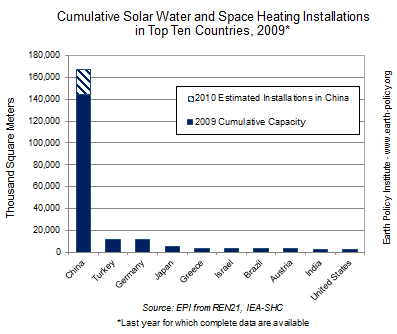
The pace of solar energy development is accelerating as the installation of rooftop solar water heaters takes off. Unlike solar photovoltaic (PV) panels that convert solar radiation into electricity, these "solar thermal collectors" use the sun's energy to heat water, space, or both.

China had an estimated 168 million square meters (1.8 billion square feet) of rooftop solar thermal collectors installed by the end of 2010—nearly two thirds of the world total.  This is equivalent to 118,000 thermal megawatts of capacity, enough to supply 112 million Chinese households with hot water.  With some 5,000 Chinese companies manufacturing these devices, this relatively simple low-cost technology has leapfrogged into villages that do not yet have electricity. For as little as $200, villagers can install a rooftop solar collector and take their first hot shower. This technology is sweeping China like wildfire, already approaching market saturation in some communities. Beijing’s goal is to reach 300 million square meters of rooftop solar water heating capacity across the country by 2020, a goal it is likely to exceed. 
Other developing countries such as India and Brazil may also soon see millions of households turning to this inexpensive water heating technology. Once the initial installment cost of rooftop solar water heaters is paid back, the hot water is essentially free.

In Europe, where energy costs are relatively high, rooftop solar water heaters are also spreading fast. In Austria, 15 percent of all households now rely on them for hot water. Germany is also forging ahead. Some 2 million Germans are now living in homes with rooftop solar systems. Roughly 30 percent of the installed solar thermal capacity in these two countries consists of “solar combi-systems” that are engineered to heat both water and space.

The U.S. rooftop solar water heating industry has historically concentrated on a niche market—selling and marketing more than 9 million square meters of solar water heaters for swimming pools between 1995 and 2005. Given this base, the industry was poised to mass-market residential solar water and space heating systems when federal tax credits were introduced in 2006. Led by Hawaii, California, and Florida, annual U.S. installations of these systems have more than tripled since 2005. More