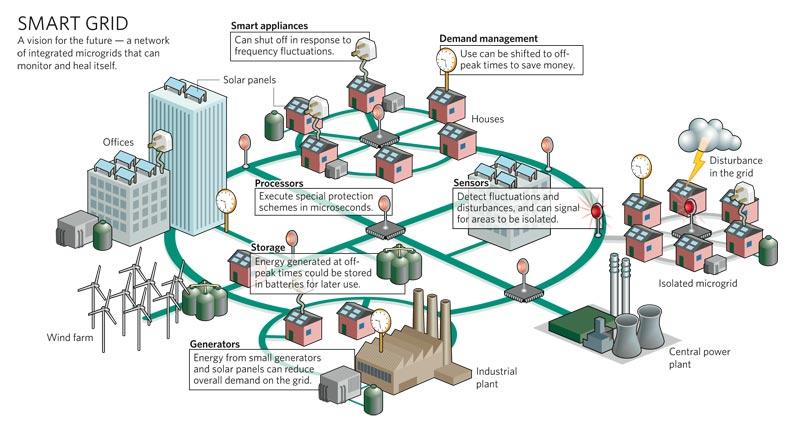
ScienceDaily (Aug. 17, 2012) — An economically feasible way to store solar energy in existing residential power networks is the subject of an award winning paper written by two Virginia Tech electrical engineers and presented at an international conference.
Reza Arghandeh of Blacksburg, Va., a doctoral candidate in the Bradley Department of Electrical and Computer Engineering at Virginia Tech, won the best student paper award at the 20th International Conference on Nuclear Engineering, held in conjunction with the American Society of Mechanical Engineering Power 2012 Conference at Anaheim, Calif.. His advisor is Robert Broadwater, professor of electrical and computer engineering, who specializes in electric power system analysis and design.
In their paper, they acknowledge that solar energy resources are "intermittent, seasonal, and non-dispatchable." However, the current national climate with its deregulation policies, electricity tariffs, control strategies and demand management are "significant tools for flexible and resilient operation of power systems with photovoltaic adoption levels," Arghandeh argued.
"Selling the household generated electricity into the electric energy market and the storage of electricity in storage systems and demand control systems provide a variety of economic opportunities for customers and utility companies to use more renewable resources," he added.
Some residential houses are already doing just this -- selling power back to an electrical distribution industry. But Arghandeh and Broadwater's work provides an optimization algorithm for a Distributed Energy Storage (DES) system on a broad scale. The system they developed presents a fleet of batteries connected to distribution transformers. The storage system can then be used for withholding distributed photovoltaic power before it is bid to market, Arghandeh explained.
"Withholding distributed photovoltaic power, probably gained from rooftop panels, represents a gaming method to realize higher revenues due to the time varying cost of electricity," he said.
Arghandeh is referring to the peak usage of energy systems such as the early evening hours when families return home from school and from work versus the low usage times that occur in the early morning hours when most households are asleep. "The distributed photovoltaic power adoption can be controlled with the help of real-time electricity price and load profile," he confirmed. More
Energy is essential to the way we live. Whether it is in the form of oil, gasoline or electricity, the worlds' prosperity and welfare depends on having access to reliable and secure supplies of energy at affordable prices. Improving how we acquire, produce, and consume energy is central to becoming economically and environmentally responsible and sustainable.
Showing posts with label smart grid. Show all posts
Saturday, August 18, 2012
Thursday, August 2, 2012
Making the Case for Smart Grid to Shave Peak Power
Smart grid technology could shave 15 percent to 20 percent off a utility or region’s peak power demand, according to estimates from the World Energy Council, IBM and others. That adds up to that many fewer fossil-fuel fired power plants a utility or region will have to build over the next few decades or so, which is good for the utility, the customers and the planet.
But how do you measure the value of a power plant never built -- and how do you justify the uncertain returns on the hard costs of deploying the smart grid to make that happen (or, not happen)?
Those are questions that the smart grid industry -- and, importantly, state and federal regulators -- will have to answer if we’re to achieve the peak-shaving potential that the smart grid promises.
“What’s the value of that avoided cost?” John Chevrette, president of management consulting division at big utility technology services firm Black & Veatch, said during a Wednesday press breakfast in San Francisco. “It’s a very debatable point in the industry.”
Chevrette and other Black & Veatch execs were in town to discuss a new report on the global energy outlook and to cover the challenges facing the water and energy industries they serve.
In broad terms, the biggest news in the energy business is the super-cheap price of natural gas, and the expectations of cheap gas for years to come, of course. That’s a challenge to wind and solar power development, but a relief to an industry that can’t build new coal-fired power plants and finds nuclear plants way too expensive and unpopular to build, he noted.
In fact, Black & Veatch predicts that 61,000 megawatts of coal power plants are set to retire between now and 2020, he said. (The U.S. Energy Information Administration says 27 gigawatts, or 27,000 megawatts, will retire over the next five years.) Replacing that will be some solar and wind, but mostly natural gas, Chevrette said, given that nuclear power’s would-be renaissance has stalled amidst economic turmoil and blowback from Japan’s Fukushima disaster -- but there’s still a lot of lost power to make up for.
“The relief valve, in many respects, for these pressures, comes down to the customers,” he said. Pushing energy efficiency, demand response and other programs to get utility customers to use less power will be a critical part of making up for that shortfall.
There’s plenty of real-world evidence of smart grid technologies cutting peak power and improving overall energy efficiency -- and more often as not, it’s been done specifically to avoid building new power plants. More
But how do you measure the value of a power plant never built -- and how do you justify the uncertain returns on the hard costs of deploying the smart grid to make that happen (or, not happen)?
Those are questions that the smart grid industry -- and, importantly, state and federal regulators -- will have to answer if we’re to achieve the peak-shaving potential that the smart grid promises.
“What’s the value of that avoided cost?” John Chevrette, president of management consulting division at big utility technology services firm Black & Veatch, said during a Wednesday press breakfast in San Francisco. “It’s a very debatable point in the industry.”
Chevrette and other Black & Veatch execs were in town to discuss a new report on the global energy outlook and to cover the challenges facing the water and energy industries they serve.
In broad terms, the biggest news in the energy business is the super-cheap price of natural gas, and the expectations of cheap gas for years to come, of course. That’s a challenge to wind and solar power development, but a relief to an industry that can’t build new coal-fired power plants and finds nuclear plants way too expensive and unpopular to build, he noted.
In fact, Black & Veatch predicts that 61,000 megawatts of coal power plants are set to retire between now and 2020, he said. (The U.S. Energy Information Administration says 27 gigawatts, or 27,000 megawatts, will retire over the next five years.) Replacing that will be some solar and wind, but mostly natural gas, Chevrette said, given that nuclear power’s would-be renaissance has stalled amidst economic turmoil and blowback from Japan’s Fukushima disaster -- but there’s still a lot of lost power to make up for.
“The relief valve, in many respects, for these pressures, comes down to the customers,” he said. Pushing energy efficiency, demand response and other programs to get utility customers to use less power will be a critical part of making up for that shortfall.
There’s plenty of real-world evidence of smart grid technologies cutting peak power and improving overall energy efficiency -- and more often as not, it’s been done specifically to avoid building new power plants. More
Subscribe to:
Posts (Atom)