Vermont has become the first U.S. state to ban the natural gas drilling practice of hydraulic fracturing, or fracking. On Wednesday, Vermont Gov. Peter Shumlin signed the measure into law at a ceremony attended by environmentalists and a group of high school students who pushed for the ban.
Gov. Peter Shumlin: "This bill will ensure we do not inject chemicals into groundwater in a desperate pursuit for energy. It is a big moment. I hope other states will follow us. The science on fracking is uncertain at best. Let the other states be the guinea pigs. Let the Green Mountain State preserve its clean water, its lakes, its rivers and its quality of life."
To watch the complete daily, independent news hour, read the transcript, download the podcast, and for more information, visit http://www.democracynow.org
FOLLOW DEMOCRACY NOW! ONLINE:

Thursday, May 17, 2012


Friday, May 11, 2012
Portugal is meeting its astonishing renewable energy target goal of 60 % by 2020
Portugal is meeting its astonishing renewable energy target goal of 60 % by 2020. with Wind. Solar. Hydro. Bio-fuels And WAVE.
Scroll down page to LISTEN to audio interview to Portugal Minister Manuel Pinho, about how Portugal is achieving its high targets for renewable energy. http://beyondzeroemissions.org/category/keywords/climate-change-policy/renewable-energy-target
Pelamis wave energy converter generating electricity into the Portuguese grid off the coast of Aguçadoura, Portugal, in October 2008. This footage was captured for the documentary 'Home' by Yann Arthus-Bertrand.
'Emptiness' sound track courtesy of Alexander Blu.
http://www.pelamiswave.com
New IMF Working Paper Models Impact Of Oil Limits On The Economy
Our Finite World
11 May, 2012
The International Monetary Fund (IMF) recently issued a new working paper called “The Future of Oil: Geology versus Technology” (free PDF), which should be of interest to people who are following “peak oil” issues. This is a research paper that is being published to elicit comments and debate; it does not necessarily represent IMF views or policy.
 The paper considers two different approaches for modeling future oil supply:
This blended model fits recent production amounts and recent price trends far better than traditional models. The forecasts it gives are concerning though. The new model indicates that (1) oil supply in the future will not rise nearly as rapidly as in the pre-2005 period and (2) oil prices are likely to nearly double in “real” (inflation-adjusted) terms by 2020. The world economy will be in uncharted territory if this happens.
It seems to me that this new model is a real step forward in looking at oil supply and the economy. The model, as it is today, points out a definite problem area (namely, the likelihood of oil high prices, if growth in oil production continues to be constrained below pre-2005 rates of increase). The researchers also raise good questions for further analysis.
At the same time, I am doubtful that the world GDP forecast of the new model is really right–it seems too high. The questions the authors raise point in this direction as well. Below the fold, I discuss the model, its indications, and some shortcomings I see. More
11 May, 2012
The International Monetary Fund (IMF) recently issued a new working paper called “The Future of Oil: Geology versus Technology” (free PDF), which should be of interest to people who are following “peak oil” issues. This is a research paper that is being published to elicit comments and debate; it does not necessarily represent IMF views or policy.
The analysis in the IMF Working Paper shows that neither approach has worked perfectly, but in recent years, forecasts of oil supply using the geological view have tended to be closer than those using the economic/technological approach. Since neither model works perfectly, the new paper takes a middle ground: it sets up a model of oil supply where the amount of oil produced is influenced by a combination of (1) geological depletion and (2) price levels.1. The economic/technological approach, used by the US Energy Information Administration (EIA) and others, and
2. The geological view, used in peak oil forecasts, such as forecasts made by Colin Campbell and forecasts made using Hubbert Linearization.
This blended model fits recent production amounts and recent price trends far better than traditional models. The forecasts it gives are concerning though. The new model indicates that (1) oil supply in the future will not rise nearly as rapidly as in the pre-2005 period and (2) oil prices are likely to nearly double in “real” (inflation-adjusted) terms by 2020. The world economy will be in uncharted territory if this happens.
It seems to me that this new model is a real step forward in looking at oil supply and the economy. The model, as it is today, points out a definite problem area (namely, the likelihood of oil high prices, if growth in oil production continues to be constrained below pre-2005 rates of increase). The researchers also raise good questions for further analysis.
At the same time, I am doubtful that the world GDP forecast of the new model is really right–it seems too high. The questions the authors raise point in this direction as well. Below the fold, I discuss the model, its indications, and some shortcomings I see. More
Thursday, May 10, 2012
Can Geoengineering Solve Global Warming? : The New Yorker
Late in the afternoon on April 2, 1991, Mt. Pinatubo, a volcano on the Philippine island of Luzon, began to rumble with a series of the powerful steam explosions that typically precede an eruption. Pinatubo had been dormant for more than four centuries, and in the volcanological world the mountain had become little more than a footnote. The tremors continued in a steady crescendo for the next two months, until June 15th, when the mountain exploded with enough force to expel molten lava at the speed of six hundred miles an hour. The lava flooded a two-hundred-and-fifty-square-mile area, requiring the evacuation of two hundred thousand people.
 Within hours, the plume of gas and ash had penetrated the stratosphere, eventually reaching an altitude of twenty-one miles. Three weeks later, an aerosol cloud had encircled the earth, and it remained for nearly two years. Twenty million metric tons of sulfur dioxide mixed with droplets of water, creating a kind of gaseous mirror, which reflected solar rays back into the sky. Throughout 1992 and 1993, the amount of sunlight that reached the surface of the earth was reduced by more than ten per cent.
The heavy industrial activity of the previous hundred years had caused the earth’s climate to warm by roughly three-quarters of a degree Celsius, helping to make the twentieth century the hottest in at least a thousand years. The eruption of Mt. Pinatubo, however, reduced global temperatures by nearly that much in a single year. It also disrupted patterns of precipitation throughout the planet. It is believed to have influenced events as varied as floods along the Mississippi River in 1993 and, later that year, the drought that devastated the African Sahel. Most people considered the eruption a calamity.
For geophysical scientists, though, Mt. Pinatubo provided the best model in at least a century to help us understand what might happen if humans attempted to ameliorate global warming by deliberately altering the climate of the earth.

The heavy industrial activity of the previous hundred years had caused the earth’s climate to warm by roughly three-quarters of a degree Celsius, helping to make the twentieth century the hottest in at least a thousand years. The eruption of Mt. Pinatubo, however, reduced global temperatures by nearly that much in a single year. It also disrupted patterns of precipitation throughout the planet. It is believed to have influenced events as varied as floods along the Mississippi River in 1993 and, later that year, the drought that devastated the African Sahel. Most people considered the eruption a calamity.
For geophysical scientists, though, Mt. Pinatubo provided the best model in at least a century to help us understand what might happen if humans attempted to ameliorate global warming by deliberately altering the climate of the earth.
Current levels of [fossil fuel] consumption “put the world perfectly on track for a six-degree Celsius rise in temperature. . . . Everybody, even schoolchildren, knows this will have catastrophic implications for all of us.” - Fatih Birol - Chief Economist - International Energy Agency. More
Wednesday, May 9, 2012
The Peak Oil Crisis: Perspective
While waiting to see how the Iranian nuclear confrontation and the various Eurozone crises sort themselves out, there is time to step back and look at the interaction of the major forces that will shape our future. While the problems of oil depletion are already upon us, shrinking resources are only a part of global dynamics currently.
 There are at least six major forces moving civilization in the world today: 1) population growth: 2) economic growth; 3) political stability; 4) technological innovation; and more recently 5) resource depletion and 6.) climate change. There are, of course, other less obvious change-producing forces at work in the world – theology, geology, and culture to name a few--but these six look like a good place to start thinking about the interaction of change. Our six forces are intertwined so that significant movement in one will eventually result in feedbacks affecting some or all of the others.
In the last 200 years a combination of better health technology and services, more productive agriculture, and improved transportation has allowed the world population to grow seven-fold. Although in some areas societal and even political measures are keeping population growth in check, as a whole the world's population is on course to increase markedly before the century is out. In a finite world this has, and will continue to have, serious implications for our other major engines of change. First is simply the need to grow and distribute food for the 78 million people that we are adding to our population each year. If one includes clothing, shelter, education, medical care, and a better-than-subsistence life style for the new arrivals, you can see that that the global economy needs to do some growing or at least rearrange the way resources are distributed.
This steadily growing population will add to resource depletion – fossil fuels, vegetation, and minerals -- for at a minimum all those additional people must eat and drink. If they are going to eat warm food or stay warm in the colder climates, they are likely to be adding to the atmosphere's growing concentration of greenhouse gases and the pace of global warming. The search for a better life is already resulting in mass migrations from poorer to richer regions which in turn is already contributing to political volatility. More
In the last 200 years a combination of better health technology and services, more productive agriculture, and improved transportation has allowed the world population to grow seven-fold. Although in some areas societal and even political measures are keeping population growth in check, as a whole the world's population is on course to increase markedly before the century is out. In a finite world this has, and will continue to have, serious implications for our other major engines of change. First is simply the need to grow and distribute food for the 78 million people that we are adding to our population each year. If one includes clothing, shelter, education, medical care, and a better-than-subsistence life style for the new arrivals, you can see that that the global economy needs to do some growing or at least rearrange the way resources are distributed.
This steadily growing population will add to resource depletion – fossil fuels, vegetation, and minerals -- for at a minimum all those additional people must eat and drink. If they are going to eat warm food or stay warm in the colder climates, they are likely to be adding to the atmosphere's growing concentration of greenhouse gases and the pace of global warming. The search for a better life is already resulting in mass migrations from poorer to richer regions which in turn is already contributing to political volatility. More
Thursday, May 3, 2012
Nuclear power is only solution to climate change, says Jeffrey Sachs
Earth Institute director says urgency of problem and immaturity of renewable energy industry leave little option but nuclear?
 Combating climate change will require an expansion of nuclear power, respected economist Jeffrey Sachs said on Thursday, in remarks that are likely to dismay some sections of the environmental movement.
Prof Sachs said atomic energy was needed because it provided a low-carbon source of power, while renewable energy was not making up enough of the world's energy mix and new technologies such as carbon capture and storage were not progressing fast enough.
"We won't meet the carbon targets if nuclear is taken off the table," he said.
He said coal was likely to continue to be cheaper than renewables and other low-carbon forms of energy, unless the effects of the climate were taken into account.
"Fossil fuel prices will remain low enough to wreck [low-carbon energy] unless you have incentives and [carbon] pricing," he told the annual meeting of the Asian Development Bank in Manila.
A group of four prominent UK environmentalists, including Jonathon Porritt and former heads of Friends of the Earth UK Tony Juniper and Charles Secrett, have been campaigning against nuclear power in recent weeks, arguing that it is unnecessary, dangerous and too expensive. Porritt told the Guardian: "It [nuclear power] cannot possibly deliver – primarily for economic reasons. Nuclear reactors are massively expensive. They take a long time to build. And even when they're up and running, they're nothing like as reliable as the industry would have us believe."
But Sachs, director of the Earth Institute and professor of sustainable development at Columbia University in the US, said the world had no choice because the threat of climate change had grown so grave. He said greenhouse gas emissions, which have continued to rise despite the financial crisis and deep recession in the developed world, were "nowhere near" falling to the level that would be needed to avert dangerous climate change.
He said: "Emissions per unit of energy need to fall by a factor of six. That means electrifying everything that can be electrified and then making electricity largely carbon-free. It requires renewable energy, nuclear and carbon capture and storage – these are all very big challenges. We need to understand the scale of the challenge." More
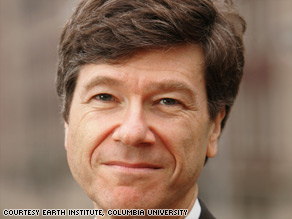
Prof Sachs said atomic energy was needed because it provided a low-carbon source of power, while renewable energy was not making up enough of the world's energy mix and new technologies such as carbon capture and storage were not progressing fast enough.
"We won't meet the carbon targets if nuclear is taken off the table," he said.
He said coal was likely to continue to be cheaper than renewables and other low-carbon forms of energy, unless the effects of the climate were taken into account.
"Fossil fuel prices will remain low enough to wreck [low-carbon energy] unless you have incentives and [carbon] pricing," he told the annual meeting of the Asian Development Bank in Manila.
A group of four prominent UK environmentalists, including Jonathon Porritt and former heads of Friends of the Earth UK Tony Juniper and Charles Secrett, have been campaigning against nuclear power in recent weeks, arguing that it is unnecessary, dangerous and too expensive. Porritt told the Guardian: "It [nuclear power] cannot possibly deliver – primarily for economic reasons. Nuclear reactors are massively expensive. They take a long time to build. And even when they're up and running, they're nothing like as reliable as the industry would have us believe."
But Sachs, director of the Earth Institute and professor of sustainable development at Columbia University in the US, said the world had no choice because the threat of climate change had grown so grave. He said greenhouse gas emissions, which have continued to rise despite the financial crisis and deep recession in the developed world, were "nowhere near" falling to the level that would be needed to avert dangerous climate change.
He said: "Emissions per unit of energy need to fall by a factor of six. That means electrifying everything that can be electrified and then making electricity largely carbon-free. It requires renewable energy, nuclear and carbon capture and storage – these are all very big challenges. We need to understand the scale of the challenge." More
Wednesday, May 2, 2012
Small Island States Take Steps to Become Energy Independent and End Poverty
High-level forum in Barbados to chart a new 'Sustainable Energy for All' roadmap ahead of "Rio+20" Conference, UNDP
 The Government of Barbados, the United Nations Development Programme (UNDP) and the Organisation of Eastern Caribbean States will host from 7 to 9 May 2012 the High-Level Conference of the Small Island Developing States (SIDS): Achieving Sustainable Energy for All in SIDS and the Rio+20 Informal Ministerial Meeting.
Prime Minister of Barbados Freundel Stuart and UNDP Resident Representative in Barbados Michelle Gyles-McDonnough will open the Conference which will discuss policy strategies leading to universal access to energy, increase in renewable energy production and energy efficiency.
Convened less than two months before world leaders gather in Brazil for the UN Conference on Sustainable Development "Rio+20", the Bridgetown Conference brings together high level representatives of 39 countries from the Caribbean, the Pacific, Indian Ocean, and Africa, that belong to the Small Island Developing States group.
"Small island developing states can leap toward the goal of a poverty free and prosperous future by changing their energy sectors," said Prime Minister Stuart. "Just weeks before the Rio+20 Conference, our countries can rally the international community with a unified voice, sharing our aspiration to become fully sustainable, and to contribute to a meaningful outcome of the meeting in Rio de Janeiro." More

Prime Minister of Barbados Freundel Stuart and UNDP Resident Representative in Barbados Michelle Gyles-McDonnough will open the Conference which will discuss policy strategies leading to universal access to energy, increase in renewable energy production and energy efficiency.
Convened less than two months before world leaders gather in Brazil for the UN Conference on Sustainable Development "Rio+20", the Bridgetown Conference brings together high level representatives of 39 countries from the Caribbean, the Pacific, Indian Ocean, and Africa, that belong to the Small Island Developing States group.
"Small island developing states can leap toward the goal of a poverty free and prosperous future by changing their energy sectors," said Prime Minister Stuart. "Just weeks before the Rio+20 Conference, our countries can rally the international community with a unified voice, sharing our aspiration to become fully sustainable, and to contribute to a meaningful outcome of the meeting in Rio de Janeiro." More
Subscribe to:
Posts (Atom)